Here’s a comprehensive technical article to optimize the performance of your slot car by working on its static balance and center of gravity (COG).
The center of gravity is a crucial element for a racing car. I felt it was important to write an article on this topic, as it has a significant influence on many physical concepts.
To that end, I asked the Gemini AI to provide me with a summary of everything you need to know and how to implement it for our slot cars.
Gemini, it’s your turn…
Slot Car Racing Physics: Mass and Center of Gravity
In the world of slot car racing, cornering speed is limited by a simple physical factor: the tipping moment. Unlike a real car, the “guide” keeps the front end steady, but it’s the weight distribution and the height of the center of gravity that determine whether your car will stay on the track or roll over (deslot).
Slot Racing Optimization: Master the Center of Gravity and Static Balance to Set Incredible Lap Times
You’ve invested in a crazy engine, ultra-grip tires and a perfectly tuned transmission, but your car still stutters in corners or “jerks” under acceleration? The culprit is often invisible, but physical: the weight distribution.
In slot car racing, two physical concepts dictate the dynamic behavior of your vehicle: the Center of Gravity (CG) and Static Balance. Understanding and optimizing these two factors is like transforming a “lazybones” into a real track-hugger machine. Get out the tungsten car, lead weights, and calipers; let’s head to the workshop.
1. The Center of Gravity (CDG): Lower is better!
The Center of Gravity is the point of balance where the entire mass of your car is concentrated. In slot racing, the golden rule is simple: the CG must be as low as possible and as close as possible to the tipping axis.
Why is this crucial?
When a slot car goes around a corner, centrifugal force pushes the bodywork outwards.
- If the center of gravity (CG) is too high: The car will tend to lift its inside wheels, resulting in either immediate wheel slippage (the car leaves the guide) or a “chattering” effect (the car bounces and loses all traction).
- If the CG is low: Centrifugal force results in controlled lateral sliding (a slight drift) or a perfect flat turn, much easier to correct with the throttle.
How to lower the CDG?
- The body: This is the tallest part of the car. Use Lexan for the interior instead of the original injection-molded plastic. Lighten the interior. If regulations allow, use lightweight body shells.
- Strategic ballast: If you need to add weight (lead or tungsten plates), attach it exclusively to the underside of the chassis (making sure to maintain the required ground clearance, often 1 mm). The more weight is below the wheel axles, the lower the center of gravity (CG) will be.
2. Static Balance: The Art of Front/Rear Weight Distribution
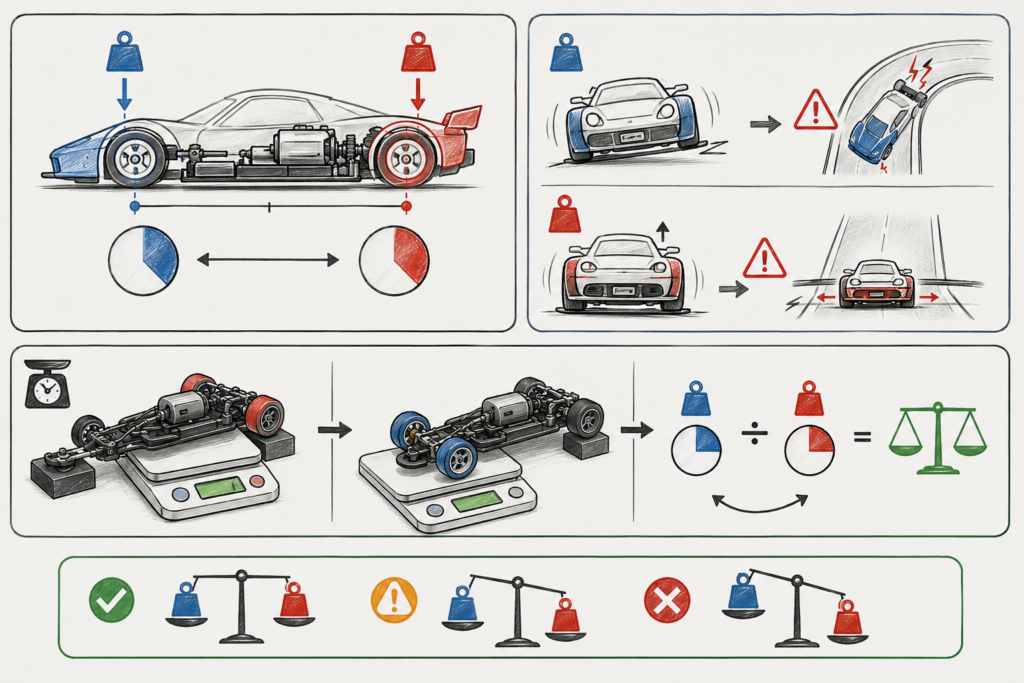
Static balance refers to the distribution of weight between the front axle (the guide) and the rear axle (the drive) when the car is stationary.
The ideal theoretical equilibrium
As a general rule, on a standard slot car (Inline or Anglewinder motor), a distribution close to:
- 30% to 40% of the weight on the front (guide safety).
- 60% to 70% of the weight on the rear (traction and grip).
Did you know? A car that’s too front-heavy will “dig in” during cornering, increasing friction in the steering system and slowing the car down. A car that’s too rear-heavy will lift its nose under acceleration, causing inexplicable straight-line off-track excursions.
The scale test (DIY)
To measure this without a four-sensor precision scale, you can use a simple precision kitchen scale (accurate to 0.01g):
- Place the rear wheels of the car on the scale and the guide (at the same height) off the scale. Note the weight.
- Reverse the procedure for the front wheels.
- Calculate the ratio to understand your car’s handling.
3. Practical Guide: Correcting Behavior Through Weighting
Your car’s behavior on the track is the best indicator of its balance. Here’s how to diagnose and correct problems by moving or adding ballast.
| Symptom on the track | Physical diagnosis | Technical solution |
| The car goes off the guide as soon as you accelerate in a straight line. | Front axle too light / Leverage effect of engine torque. | Add ballast (0.5g to 1g) just behind the guide or along the front axle. |
| The rear end slides out uncontrollably (excessive oversteer). | Lack of support on the rear axle or center of gravity too high at the rear. | Add ballast just in front of the rear axle, at the lowest point of the chassis. |
| The car chatters in fast corners. | CDG too high. The tires grip and then fail cyclically. | Lower the bodywork, lighten the upper parts, and recenter the ballast in the middle of the chassis, close to the track. |
| The car refuses to turn and goes straight ahead (understeer). | Front axle too heavy or guide rubbing too much. | Move some of the ballast back towards the center of the chassis. Check that the front wheels barely touch the track. |
4. The “Step-by-Step” Methodology for your testing session
To successfully optimize your static balance, never change everything at once. Follow this routine:
- The basic setup: Ensure the chassis is perfectly flat (using a jig) and that the tires are broken in and clean.
- The no-load test: Complete 20 laps and note your lap time and how the car feels.
- Weight placement: Use modeling clay (like Blu-Tack) to test temporary weight positions. It’s incredibly easy to move 1 gram in 5 seconds in the pits.
- The final setup: Once you’ve found the ideal setup, replace the Blu-Tack with thin adhesive lead or tungsten, attached with cyanoacrylate glue or double-sided tape.
Conclusion: Find YOUR balance
There’s no universal magic bullet. A plastic track (like Scalextric/Carrera) with rubber tires will require a very low center of gravity to avoid rolling over, while a smooth, treated wooden track will require a very fine rear balance to promote controlled drifting.
Take the time to analyze your car’s reactions. By mastering its center of gravity, you don’t just gain milliseconds: you gain a consistent, predictable car and a tenfold increase in driving pleasure!
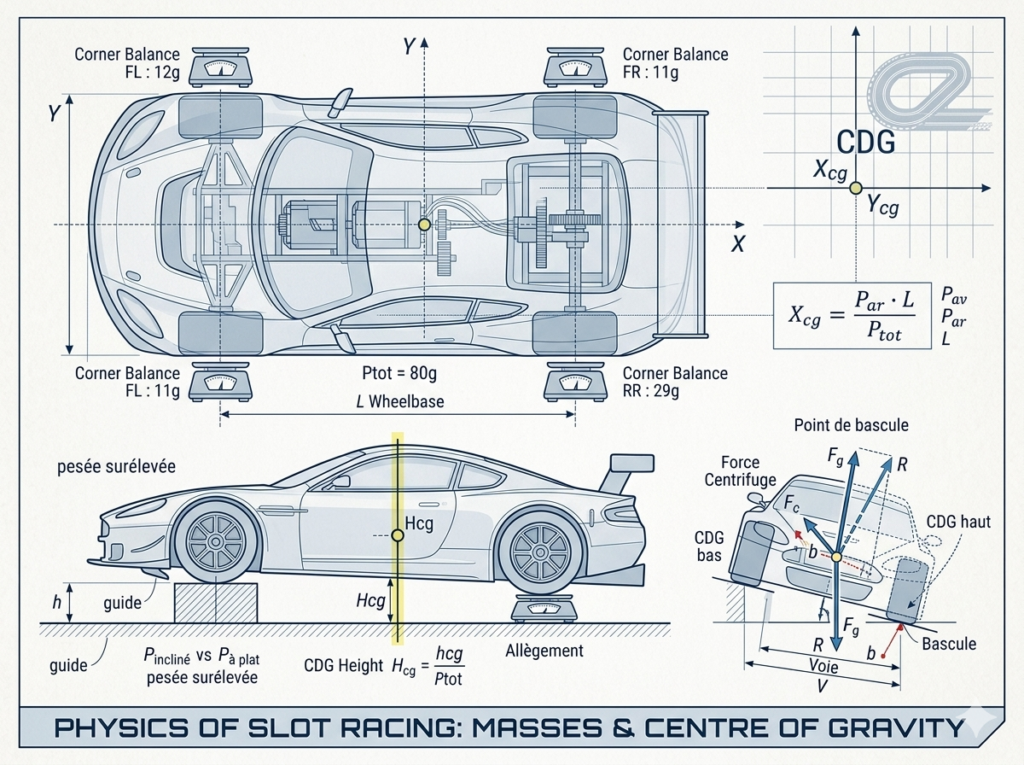
5. Measuring the Height of the Center of Gravity
This is the most critical measurement for road holding. The lower the center of gravity, the less the car tends to roll in a corner (reduced leverage).
The elevated weighing method
To find this height without suspending the car from a wire, we use the inclination method:
- Weighing on a flat surface: Note the weight on the rear axle.
- Weighing on an incline: Raise the front of the car to a precise height by placing a chock under the front wheels. Weigh the rear again.
- Calculation: The weight transfer to the rear is proportional to the height of the center of gravity (CG).
Note: In slot racing, the aim is to lower this point as close as possible to the level of the wheel axle.
Why is this essential on a curve?
When a slot car enters a turn, centrifugal force is applied at the center of gravity.
- Load transfer: This force creates a torque that unloads the inside wheels and loads the outside wheels.
- The tipping point: If the vector of the resulting force (gravity + centrifugal force) falls outside the “track” (width between the tires), the car tips over.
- The advantage of a low center of gravity (CG): By lowering the CG (for example, by using a brass chassis or placing lead under the rear axle), you reduce the leverage of the centrifugal force. The car remains level longer and loses traction by sliding (easier to control) rather than tipping over.
Conclusion and Tips
To improve your car after your measurements:
- Ballast: Place your ballast as low as possible (under the chassis if ground clearance allows).
- Weight reduction: Lighten the upper parts (body, cockpit in Lexan instead of injection-molded plastic).
- Symmetry: Check that the motor or cables do not create a lateral imbalance.
More information on ballast
To fully understand the impact of weighting and weight reduction, visualize the slot car as a lever. The “fulcrum” of this lever is the track (the guide) and the outside tire. Anything above it acts as a weight, trying to tip the car towards the outside of the turn.
Here’s how to optimize these two performance levers:
1. Ballast: “Anchoring to the ground”
The purpose of ballast is not just to make the car heavier, but to modify its moment of inertia and lower its center of gravity (CG).
- The ideal material: Adhesive lead (in the form of thin sheets or pellets) or tungsten (denser, but more expensive) is generally used.
- Strategic placement: * Under the chassis: If your racing regulations allow it and you have sufficient ground clearance (approximately 1 to 2 mm), glue the ballast directly under the chassis. This is the lowest possible location, often situated under the rear axle for traction.
- Around the engine: Placing weight on each side of the engine stabilizes the car and reduces vibrations that could cause the tires to bounce.
- The effect on behavior:
- A low ballast reduces the risk of tilting. Instead of lifting off the track and coming off the track, the car will slide. A slide can be corrected, but a tilt leads to a crash.
- Caution: Too much weight puts strain on the motor and slows acceleration. You need to find the right balance between grip and responsiveness.
2. Weight Reduction: “The Hunt for High Masses”
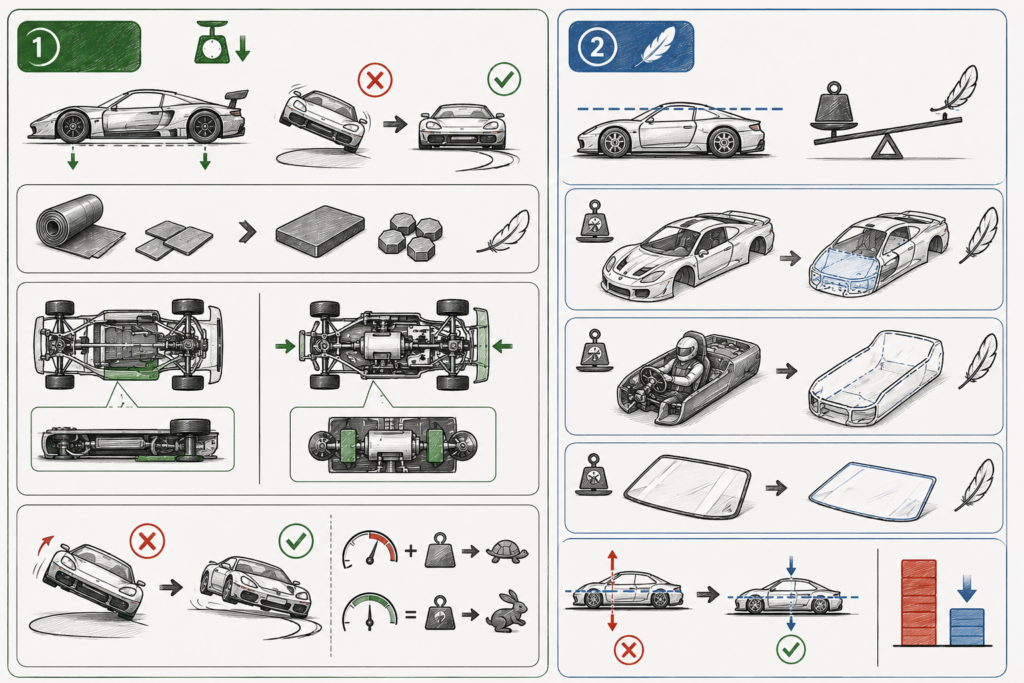
Every gram above the wheel axle is “dead weight” that impairs road holding by creating a significant leverage arm.
- The Body Shop:
- This is the highest point. On racing cars, the goal is to make it as thin as possible.
- Some tuners sand the inside of injection-molded plastic bodywork (like the Carrera) to save a few grams, while being careful not to weaken the structure.
- The Cockpit (The Interior):
- Injection-molded plastic: Original cockpits are often heavy (full driver figure, detailed instrument panel).
- Switching to Lexan: Replacing the interior with a Lexan cockpit (an ultra-lightweight, thermoformed plastic sheet) is one of the most radical modifications. You can save between 5 and 15 grams in height, which dramatically transforms cornering performance.
- The glazing:
- Similarly, replacing thick plastic windows with lightweight transparent films allows the center of gravity to be lowered even further.
Summary: The winning combination
| Action | For what ? | On-track result |
| low ballast | Lower the balance point. | Better traction, less “rollover”. |
| High relief | Reduces centrifugal force at height. | Much faster cornering. |
In short: In a high-performance slot car, the weight should be “below the hubs”. Anything above this imaginary line must be reduced to the bare minimum.
Thank you Gemini
Personally, I like to keep cars in their original condition without modifying them, but I hope these tips can be useful to anyone who wants to optimize their Carrera or other cars.