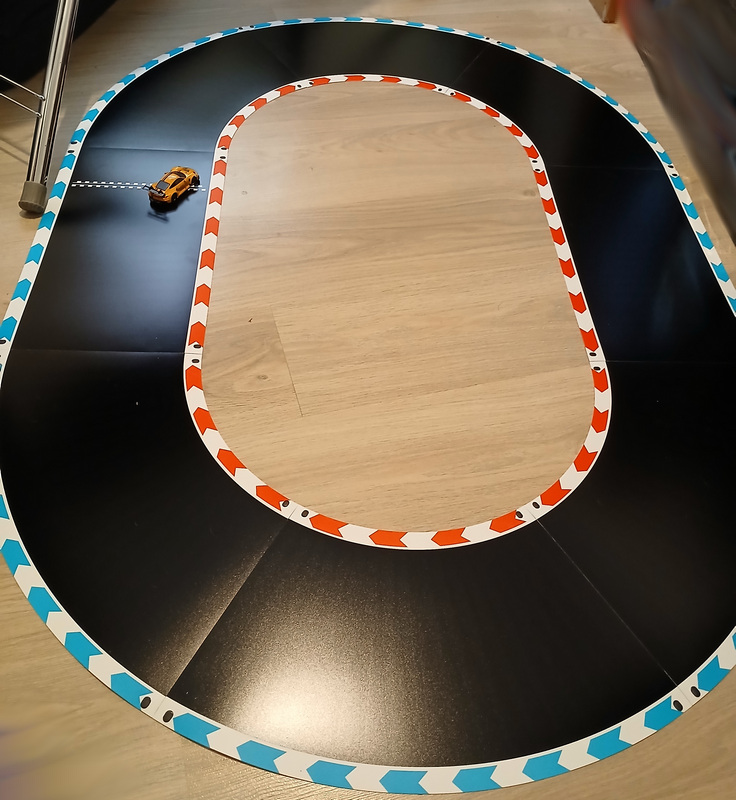
The HYBRID track is an interesting topic. We’ve talked a lot about road circuit tracks, including the GO, First, and 1/24th-level track ranges. The types of rails, the possibilities, the crazy things you can do. Now it’s the turn of the latest CARRERA model, the HYBRID.
Please note, we’re not talking about a road circuit track with slots to guide the cars. And while this feature may seem like a simple feature, there are some hidden constraints in this range.
Let’s start by talking about dimensional specifications.
Dimensions
The track width is 250mm (as a reminder, the GO has a width of 114mm and the 1/24th track (200mm)).
What we notice is that the cars are on a 1/50th scale, yet this is the widest track compared to the 1/43rd GO range and the 1/24th track.
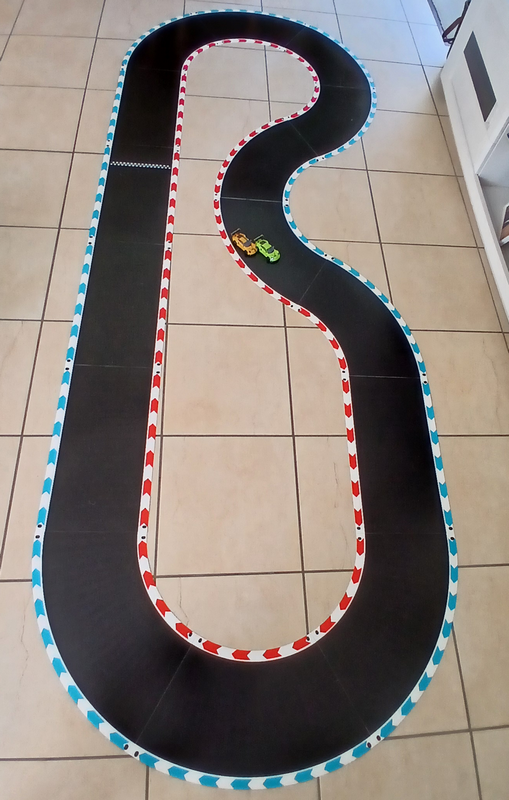
The length of a standard straight track is 433mm, compared to 342mm for the GO track and 345mm for the 1/24° track.
Once again, we have the longer dimension.
For curves, we have a system based on a 60° angle like the 1/24° track, while the GO track is based on a 90° system.
Curvature radius R1
Inner radius: 250mm
Outer radius: 500mm
60° angle
Curvature radius R2
Inner radius: 1000mm
Outer radius: 1250mm
30° angle
Flexible track with a thickness of 0.9mm and 2.6mm at the joints.
The edges (white – (blue/red)) are 21mm wide, leaving a black track of 250-(2×21) = 208mm.
The width of a car is approximately 39mm, which means that theoretically it is possible to fit (208/39=5.33) 5 cars side by side.
For comparison, a Formula 1 track has an average width of approximately 10m and a Formula 1 car has a width of approximately 2m, so 5 Formula 1 cars fit within the width. We are in the same proportions.
Special features of the HYBRID track
Compared to a road circuit track, which has the constraints of thickness and slots for the car guides, none of that applies here.
So we have a flat track with a blue and white track edge on the left side and a red and white track edge on the right side. This particularity is technical; we’ll come back to it later in the triangle section.
The fact that the colors are different on each side of the track means that each rail has a different direction, unlike in slot racing, where most of the elements can be assembled in either direction, or where a right turn can just as easily be a left turn.
The fastening system between the track elements is different and fits together like parquet flooring slats; they are approached at an angle and then aligned. The advantage of this system is that assembly is very, very quick and there’s no need to add fastening clips like with the 1/24 and GO tracks.
The letters
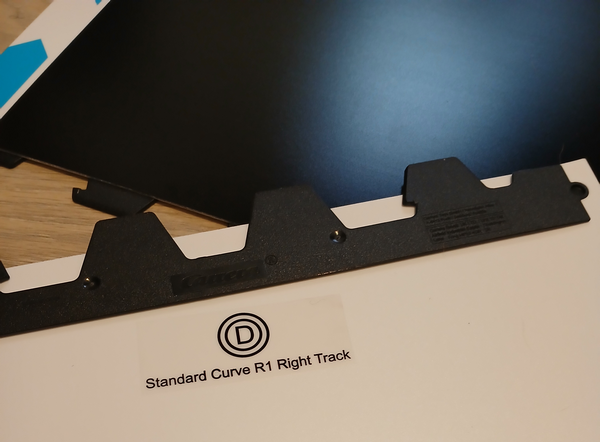
Those familiar with the CARRERA road circuit know that CARRERA rails have a reference underneath, and that the instructions refer to this reference, which is a letter.
You don’t change a formula that works; the HYBRID adopts this principle, and the reference is indicated underneath the track elements.
Here is the list of all the track elements and their letters.
| Letter | Name | Availability |
| A | Start, straight line 433mm | Available |
| B | Straight line 433mm | Available |
| C | R1 curve left 60° | Available |
| D | R1 curve right 60° | Available |
| E | Sharp left turn | Available |
| F | Sharp right turn | Available |
| G | R2 curve left 30° | Available |
| H | R2 curve right 30° | Available |
| I | Chicane | Available |
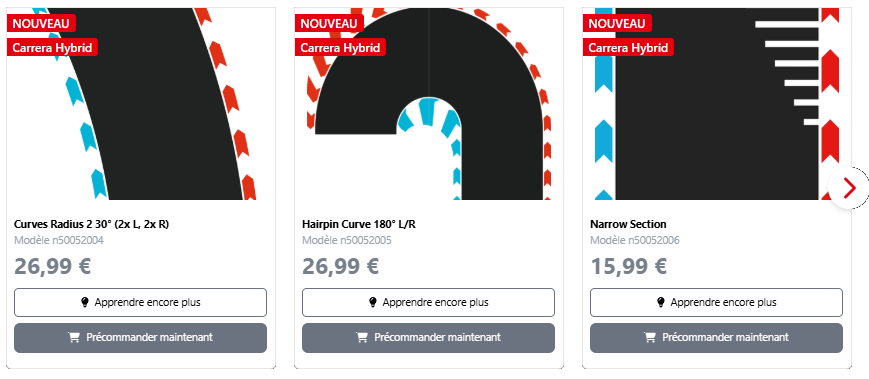
Some elements will not be available until November 2025 but will allow you to create tracks with more possibilities.
The circuit layouts
First of all, I welcome the fact that CARRERA indicates on the box all the possible layouts offered by the elements provided. No fewer than 12 are drawn, which gives good ideas depending on what you want as a circuit and the space you have available.
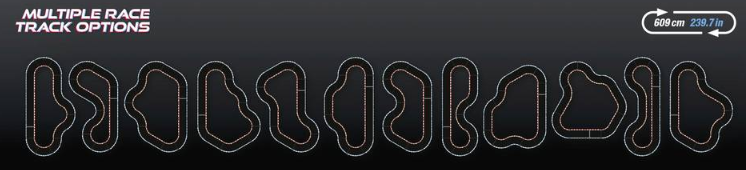
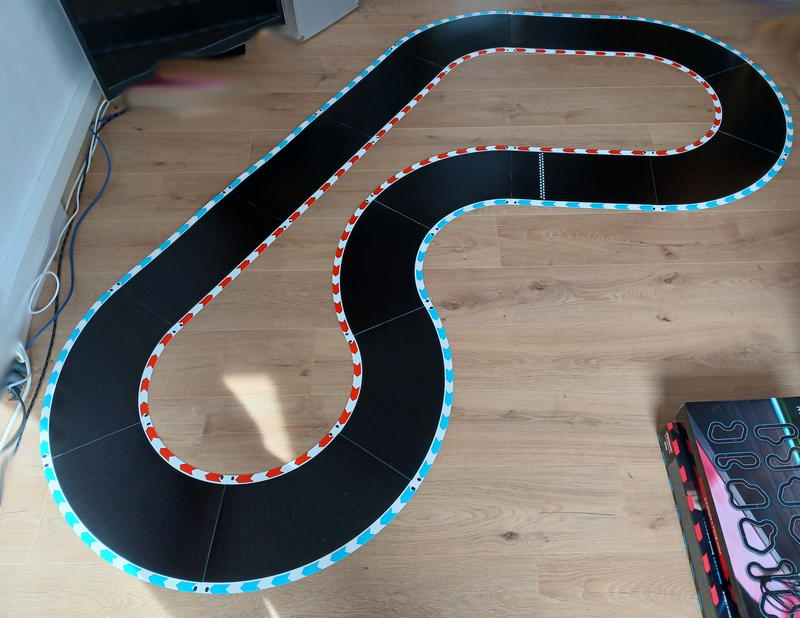
You don’t have to use all the track elements; you can just make an oval for a quick race in an area with limited space. You can see photos of some examples of tracks I’ve made in this article.
The triangles
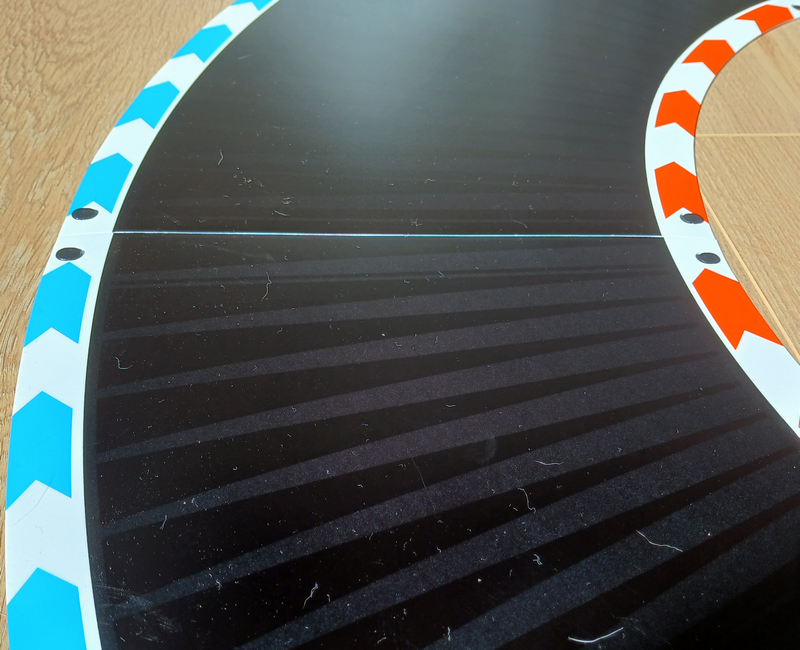
The HYBRID track has a special feature: a system that allows the car to know its position on the track. When a lot of grazing light shines on the track, triangles appear. Thanks to these triangles, the car can know its progress by counting them and looking at the width of the triangle, the car knows whether it is on the left or right side of the track. A very ingenious system. Thanks to all this positioning information, a driver assistance system corrects the trajectory to keep the car on the track, and the car can drive independently and position itself on the starting grid.
It is because of this system that the curves can only be one-way and cannot be used in both directions (for left and right turns).
Accessories
It’s possible to add elements to make the track more fun. While road circuit tracks require special elements, here, you simply need to add accessories because the track is flexible.
You can find elements to make on the STURMKIND website (https://www.sturmkind-shop.com/) or on 3D printing file sites:
- a bridge
- a banked turn
- a bump.
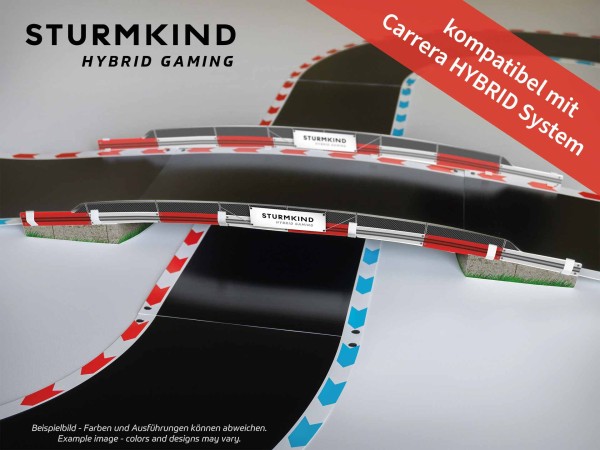
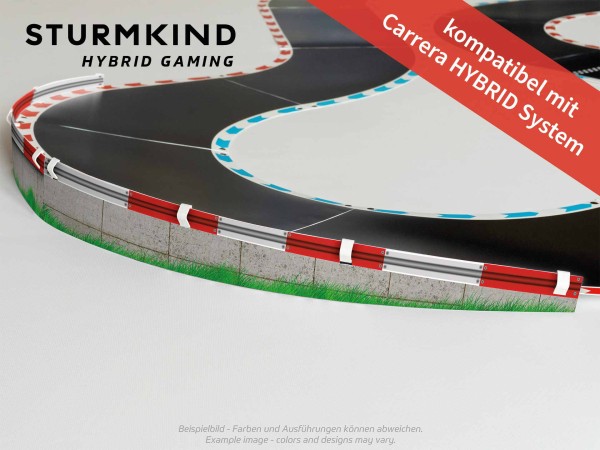
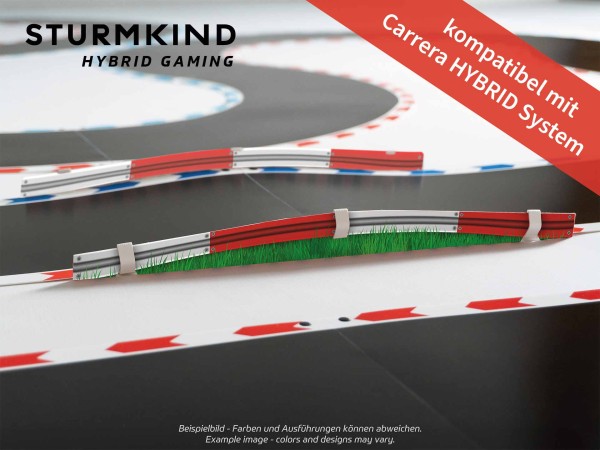
Feel free to browse the various pages of the HYBRID menu on the website.
You can also find links to other track accessories.
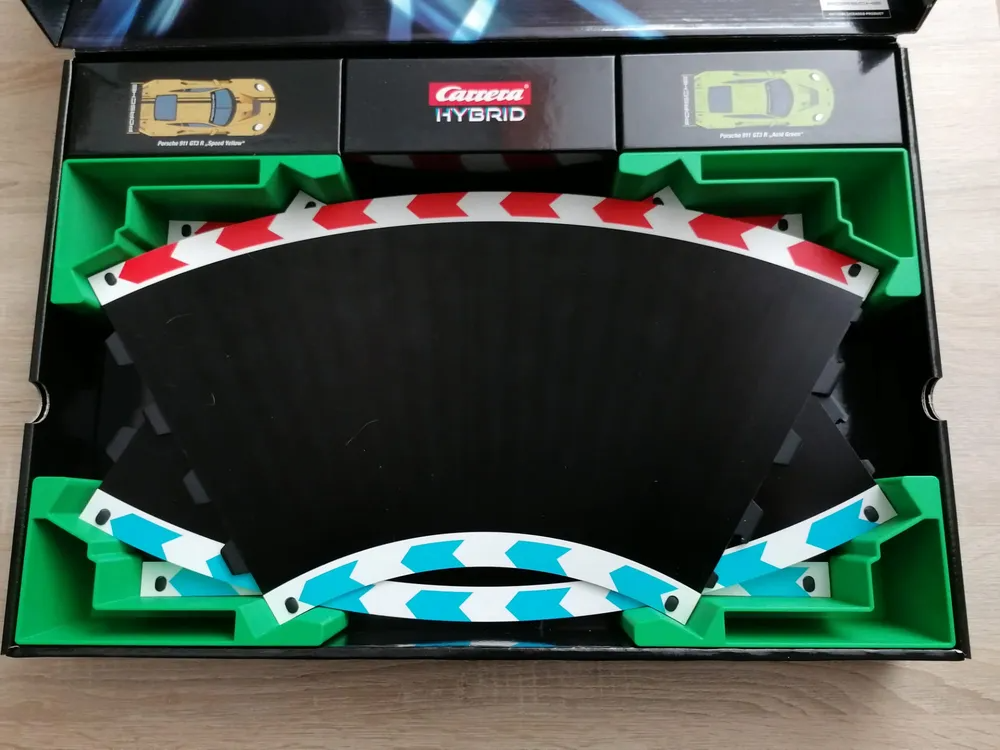
I’d like to talk about the components that allow the track elements to be properly positioned in the box. This is important because the track surface must be preserved so that the car can find its position with the wishbones.
These four components are designed to allow the insertion of straight lines or R1 curves.
Cleaning
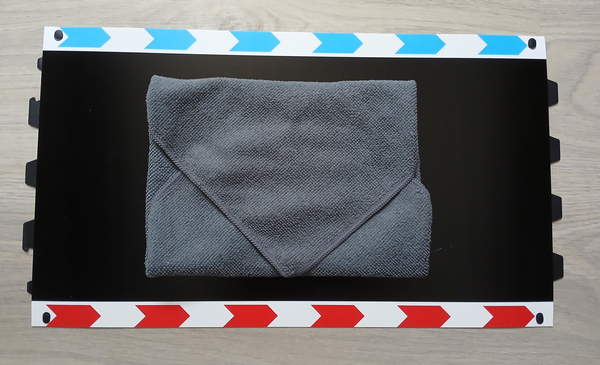
For small cars, a little dust is a big deal. And you have to keep the tires clean.
To easily clean the track, I use a microfiber cloth that I’ve dedicated to the HYBRID.
So I always have my cloth handy to wipe it down regularly so it stays clean and doesn’t clog the cars’ wheels and axles.