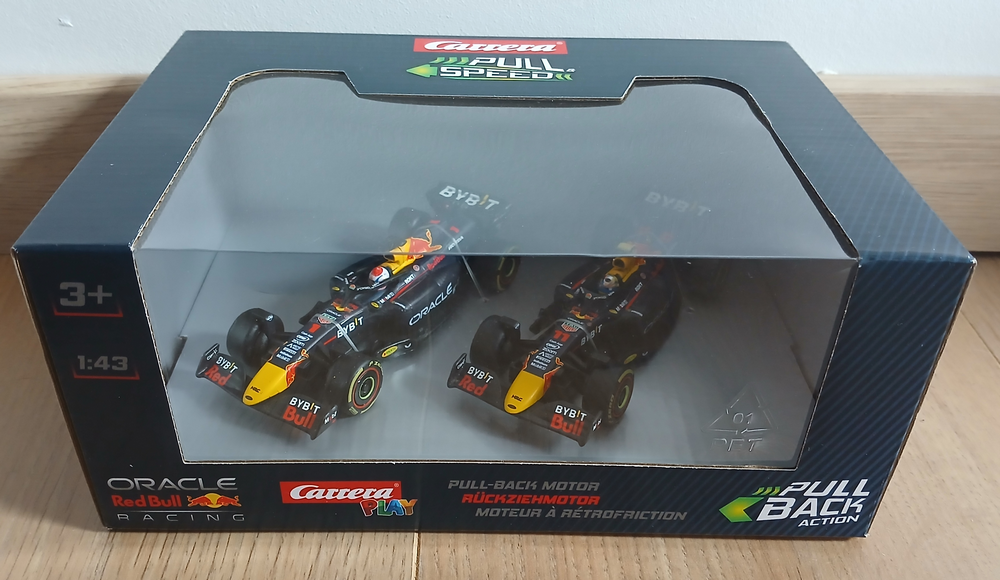
I was browsing in a toy store, checking out the new releases, when suddenly, what did I see? This beautiful Red Bull F1 pack from CARRERA’s Pull N Speed (or Pull Back Action) range. All for a very reasonable price. I didn’t hesitate for long and decided to buy my first Pull N Speed set, which I could then compare with the GO series.
So, in this set, we find two Oracle Red Bull Formula 1 cars with the following drivers:
- n°1 : Max Verstappen
- n° 11 : Sergio Pérez
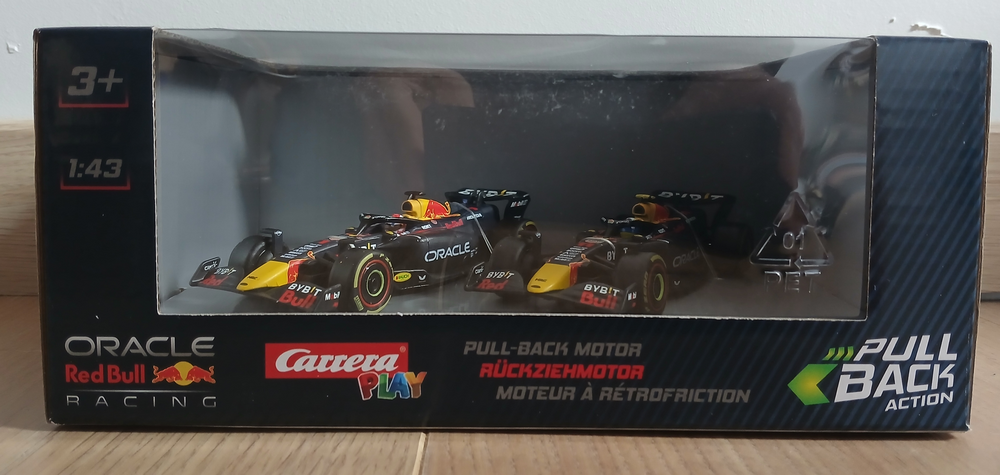
First of all, let’s talk about the Pull N Speed range which is based on the principle of retro friction, that is to say that the car is moved backwards so that it stores energy in order to release it when moving forward.
To explain the principle simply, I asked the Gemini AI to explain it to me so I could share it with you:
1/43 scale friction-powered cars, like Carrera’s Pull & Speed range, rely on a simple yet ingenious clockwork mechanism that transforms manual power into pure speed.
Here’s a breakdown of how it works, from the user’s actions to the car’s movement.
Principle
1. Energy Storage (The “Pull Back”)
Unlike electric or spring-driven cars, the friction system uses a spiral spring housed in a gear casing.
- Movement: When you push the car back, the rear wheels drive a series of gears.
- Gear Reduction: These gears are arranged so that a small wheel rotation results in a very rapid rotation of the internal mechanism.
- Storage: In the case of Pull & Speed cars, the backward movement compresses a flat spiral spring. This is elastic potential energy.
2. The Locking and Disengaging Mechanism
To prevent the car from rolling away as soon as you start to reverse it, the casing often contains a ratchet system or a rudimentary clutch.
- As you reverse, you might hear a small “click-click”: that’s the spring reaching its maximum tension.
- Once you release the car, the mechanism reverses instantly.
3. Motion Release
This is where the magic happens. The spring is abruptly released and tries to return to its original shape.
- Acceleration: The spring’s force is transmitted to the rear wheels via the gears. The gear ratio is then reversed: the spring releases slowly but makes the wheels spin very fast.
- Grip: This is why the rear tires of Carrera Pull & Speed cars are made of soft rubber. Without this grip, the wheels would spin due to the spring’s power, and the car would lose all its energy without moving forward.
Specific Features of Carrera Pull & Speed
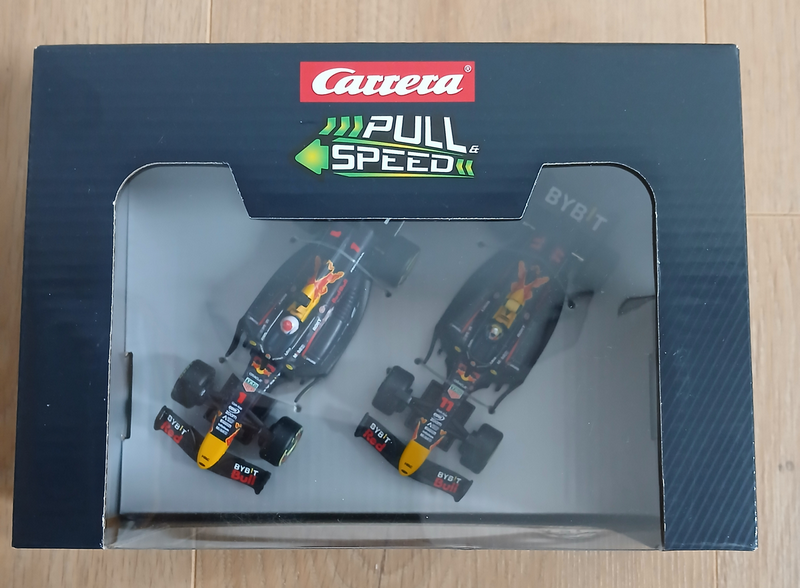
These models differ from supermarket toys in two ways:
- The Gear Ratio: They are tuned for a high top speed relative to their size.
- Realism: Although these are friction-powered toys, the bodywork is officially licensed (Ferrari, Red Bull Racing, etc.), faithfully reproducing the aerodynamic details of real race cars.
In short: You act like a human gas station. By pulling the car backward, you “fill up” the spring with mechanical energy, which is then released all at once to propel the vehicle.
Thank you Gemini for this very clear explanation, I just needed to tweak 2 sentences in which the AI got a little carried away.
The F1 Pull N Speed
After taking the cars out of the box, I found myself with cars that strongly resembled the CARRERA GO F1 cars.
The quality of the plastic and tires is identical, as is the bodywork decoration.
It’s time to try the Pull N Speed system. I find enough space in the living room for the F1 car to move freely. I gently back the Formula 1 car up and release it. Off it goes, slowly slowing down until it stops. A second try, backing it up a little further to store more energy. And this time, the start is worthy of a Formula 1 Grand Prix: a fast start, and the car comes to a stop further down the road.
A quick test of the Pull N Speed system. I like to define a standard test to compare several cars, so I thought of backing the car up a simple fixed distance and seeing how far it moves forward. A 10cm back allows it to move forward 164cm.
Same warning as for F1 CARRERA GO, be careful, the wings are fragile, even if the speeds are lower and therefore the impacts are less, be careful.
Comparison with the GO version
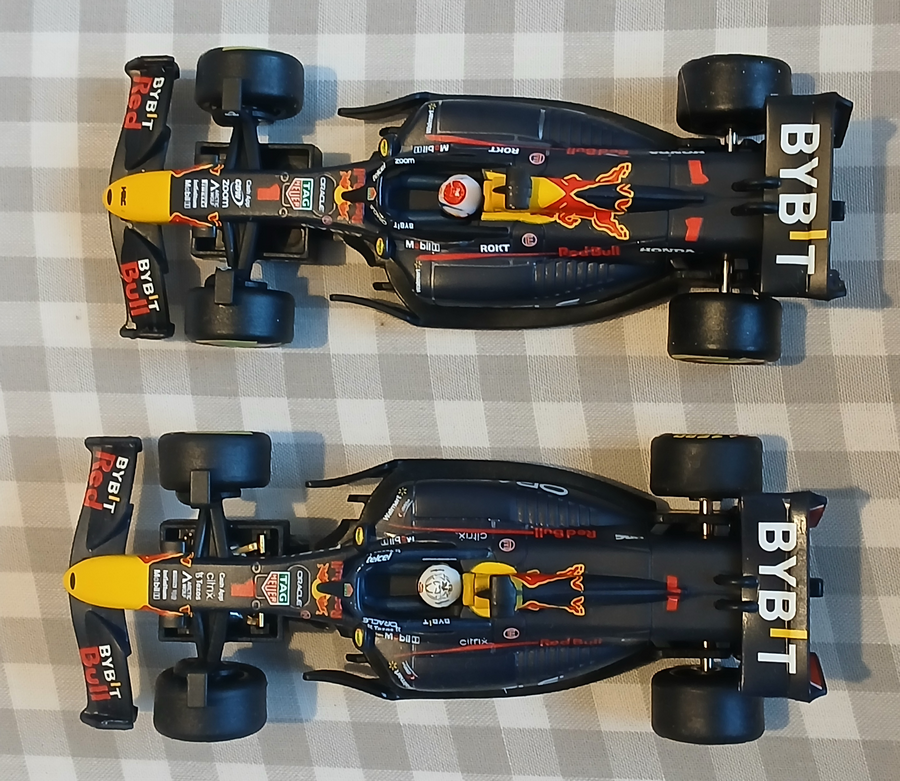
As mentioned earlier, the Pull N Speed feels very much like a Carrera Go, so let’s look at the differences.
From above, aside from the fact that they are different versions of the livery due to different years, there’s also little variation in the shape of the F1 car. To distinguish the two models, only the clips on the contact braids at the front axle give away the Go version.
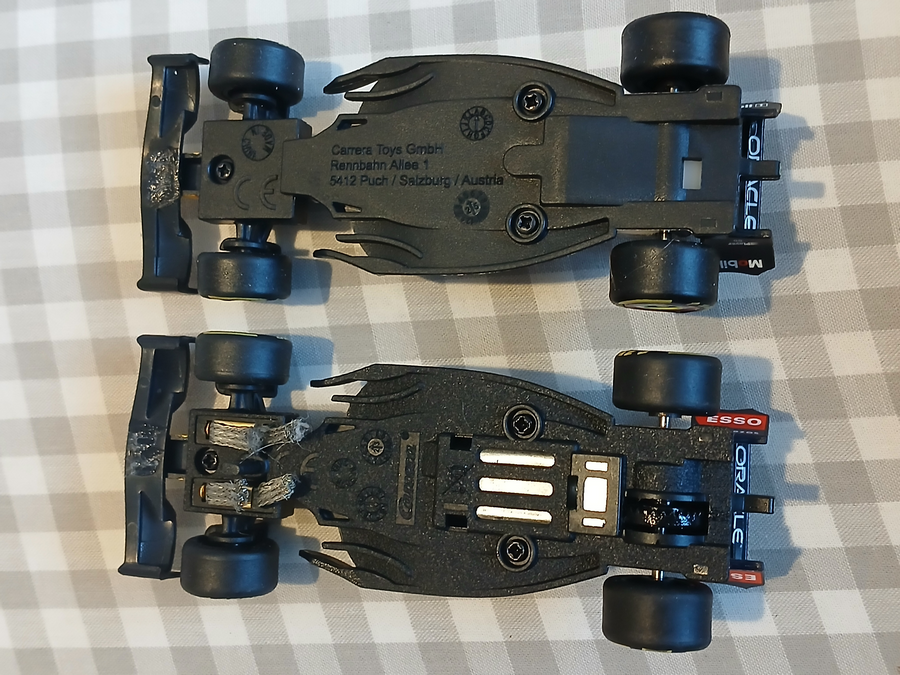
If we turn our cars over, we see more differences. The overall chassis shape is identical, but we notice some variations:
The Pull N Speed version doesn’t have braided arms at the front, but the square recess for attaching them is still there, though filled in. This is the only aesthetic flaw that hasn’t been addressed. It’s a feature inherited from the GO version.
The GO version’s magnet and motor air vent are absent.
The gear system with the motor on the rear axle is gone, replaced by the pull-back friction drive.
The chassis is therefore different to accommodate the new drive unit, but the body mounting system is identical, with screws in the same positions on both versions.
A quick weigh-in for our two racing cars:
- GO = 33.6 g
- Pull N Speed = 24.7g
The Pull N Speed is lighter, which is explained by a single component with less metal (simply the spring), whereas the Formula 1 GO has a motor, a magnet and metal braids.
The trick for the GO
As I mentioned, the screw positions are identical. A Carrera GO car costs around €23. I paid €13 for my two Formula 1 Pull N Speed cars. Yes, €13 for both cars.
If you have Vertapen’s car (number 1) and want to temporarily or permanently change the bodywork, this is a simple and inexpensive way to do so.
And if, unfortunately, you’ve broken a spoiler and glue isn’t the solution, you can acquire a new body (or even two) for a very reasonable price.
It’s worth noting that the other Pull N Speed vehicles also seem to be compatible with their respective GO counterparts, as Carrera uses the same bodies in both ranges for cost reasons.
Conclusion
Pull N Speed cars are basically well-made retro friction toy cars, but their links with the GO range make them interesting for fans of GO circuits and F1.
- Red Bull Double Action
- Reference: 5013025
- Suggested price: €13