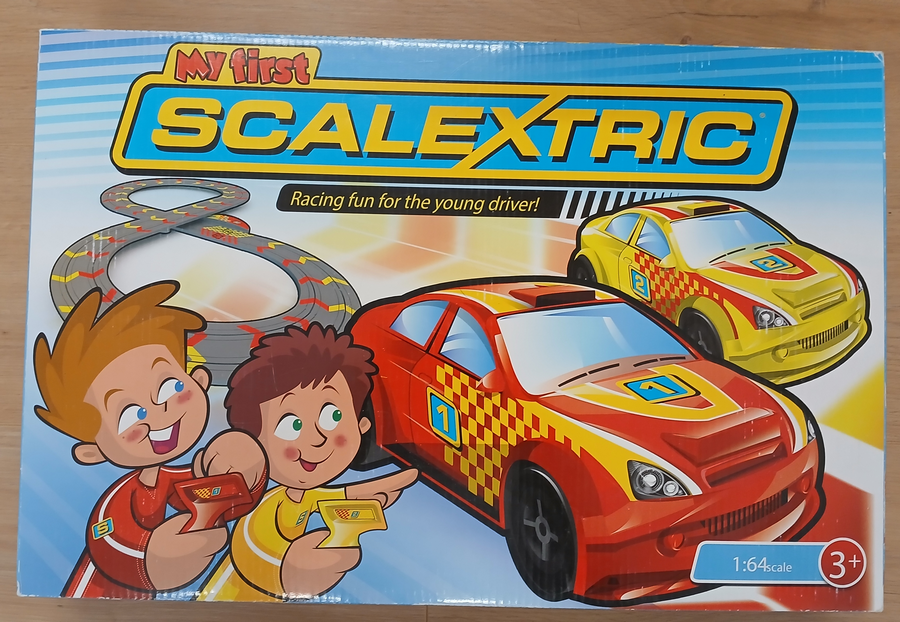
I made a trip to the United Kingdom, on the grounds of a large road circuit manufacturer Scalextric. This in no way alters my passion for CARRERA circuits, but I find it good to compare and see what other manufacturers are doing. And instead of bringing an English Mug, I brought a My First Scalextric box set.
Since I have a lot of CARRERA, I am afraid of not being objective, but I will do my best to be so.
The test circuit is a My First Scalextric box dating from before 2019 with the old Scalextric connector system.
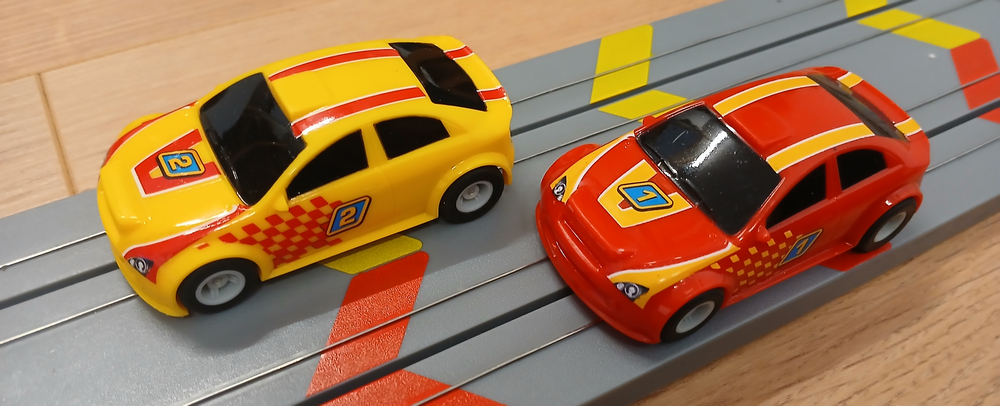
The vehicles
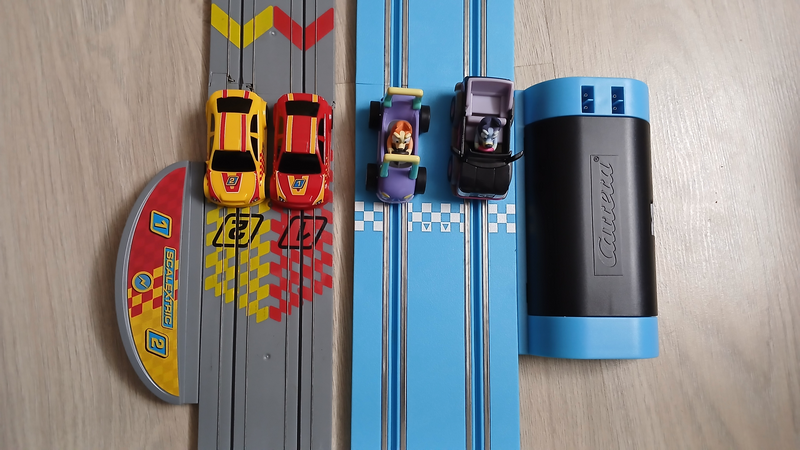
The My First vehicles are 1/64 scale, like the Micro range, while Carrera has chosen a 1/50 scale, an intermediate scale with the 1/43 scale of GO!!!.
Scalextric vehicles are very lightweight and made of basic plastic; Carrera vehicles are slightly higher quality and seem a bit more robust..
The controllers
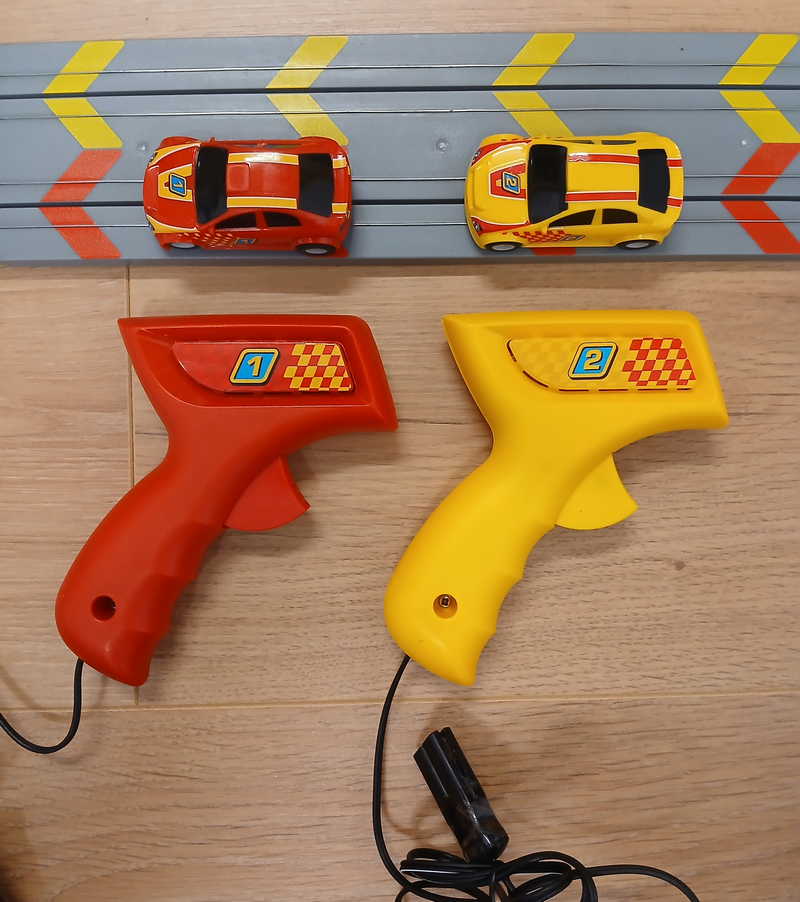
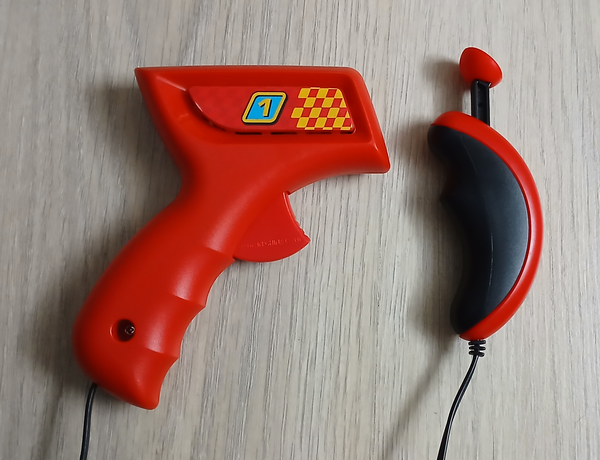
The controllers are trigger-type, operated with the index finger. In contrast, Carrera controllers use the thumb to operate the mushroom-shaped control.
The My First Scalextric controllers are larger than the Carrera ones, making them easier for adults to grip.
There are two controllers in different colors, making it easy to identify each lane, and a number is also present on the controller.
Runway elevators
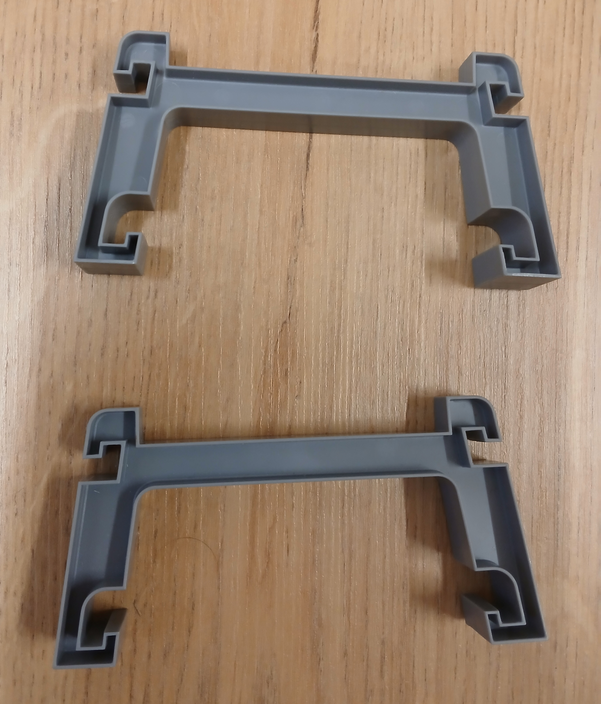
I really like the My First Scalextric track supports because they support the entire width of the track. The advantage is that the track stays horizontal and doesn’t warp like with the supports in Carrera sets.
The clever little extra is that you can stack these supports to create multiple levels.
Power
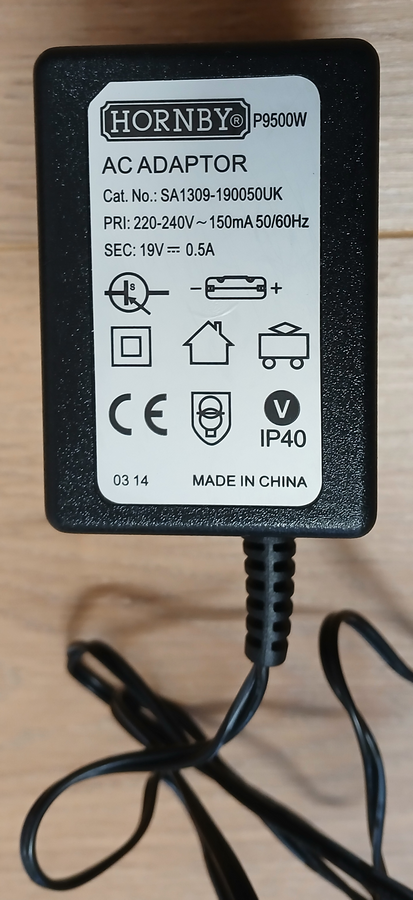
The power supply provides 19V to the starting base.
Having purchased this set in the UK, an adapter was needed for French outlets.
Carrera does not offer a mains adapter for the First range; it requires batteries, and the voltage is 6 volts, powered by four 1.5V batteries.
The track
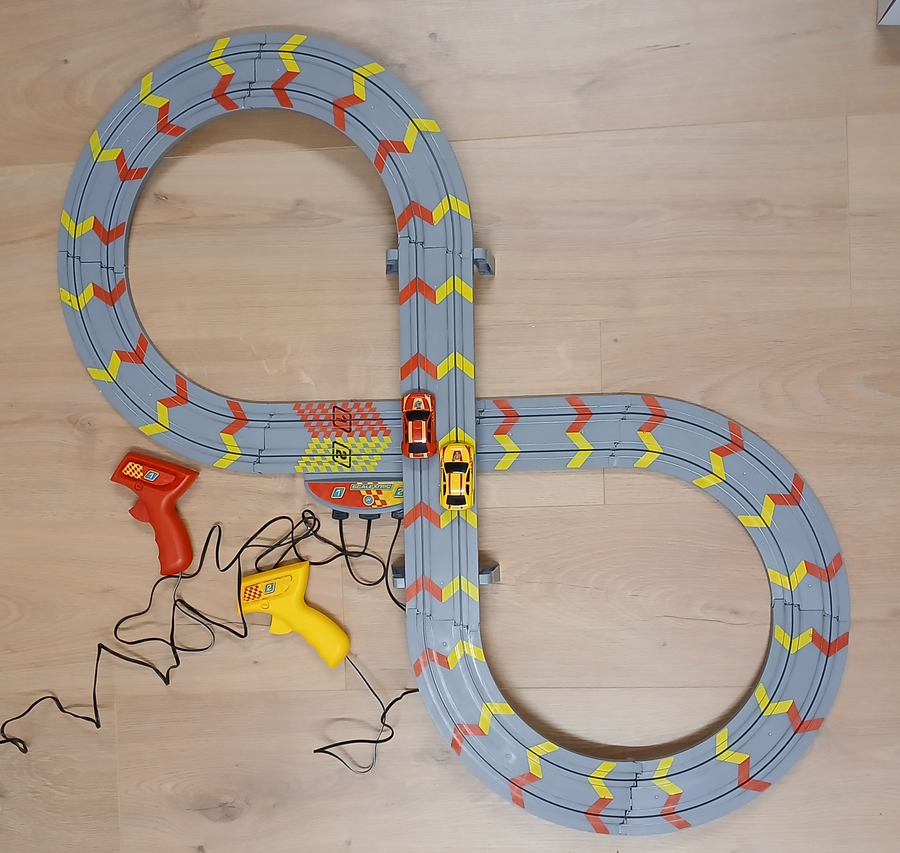
The track is basic, a simple figure eight, but the big difference is the track decoration. The entire track is made up of red and yellow arrows. Therefore, care must be taken during assembly to ensure the tracks are oriented correctly to avoid crossing the colors.
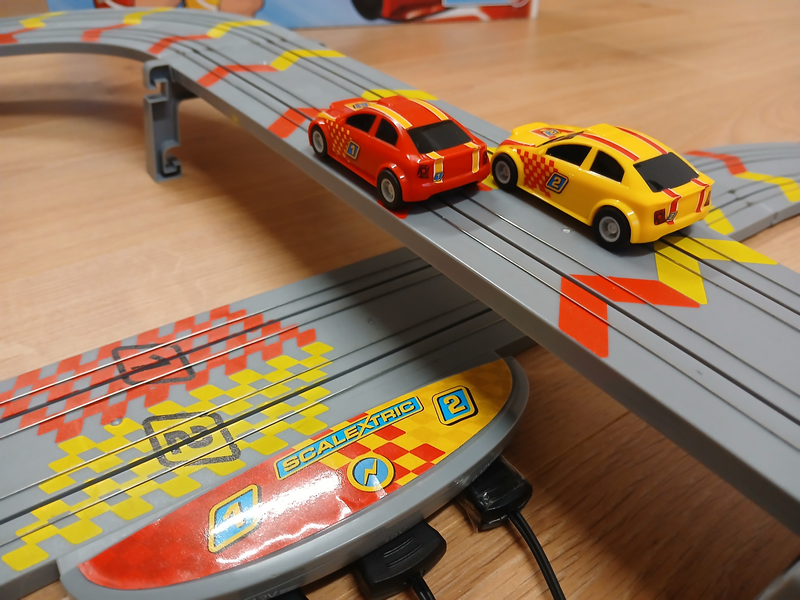
For the figure eight, a bridge allows the crossing of the tracks to be managed.
Conductive rails
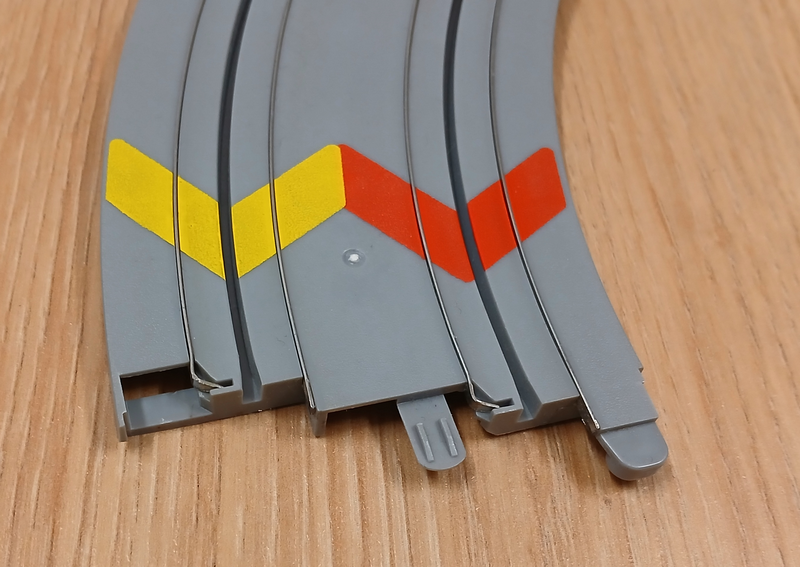
Structure and Mechanical Support
Carrera: The inverted “U” profile (Wide and Recessed)
The rail is a wide metal strip with both edges folded downwards to form a “U”. These edges are then forced into two slots in the plastic.
- Structural advantage: This profile creates a metallic “bridge.” This provides high rigidity to the contact surface itself: the rail doesn’t sink under heavy pressure.
- Anchoring: Because there are two insertion points per rail, the metal is perfectly bonded to the plastic. It cannot tilt or twist laterally.
- Disadvantage: The surface area is large, making it susceptible to thermal expansion. On very long circuits in direct sunlight, the “U” shape may sometimes warp slightly.
Micro Scalextric: The “I” profile (Thin and Flush)
Here, we have a simple vertical blade (I-profile) inserted into a single thin slot. Only the top of the blade protrudes from the track.
- Structural advantage: This is the most compact solution possible. It allows the rails to be placed as close together as possible for very narrow cars.
- Anchoring: The rails are held solely by the friction of the blade in its slot. This makes them more fragile: over time or with rough handling, the rail can protrude slightly (creating a “notch” that jams the car) or, conversely, sink in.
- Expansion: The I-beam rail handles temperature changes better because it has more longitudinal movement within its slot.
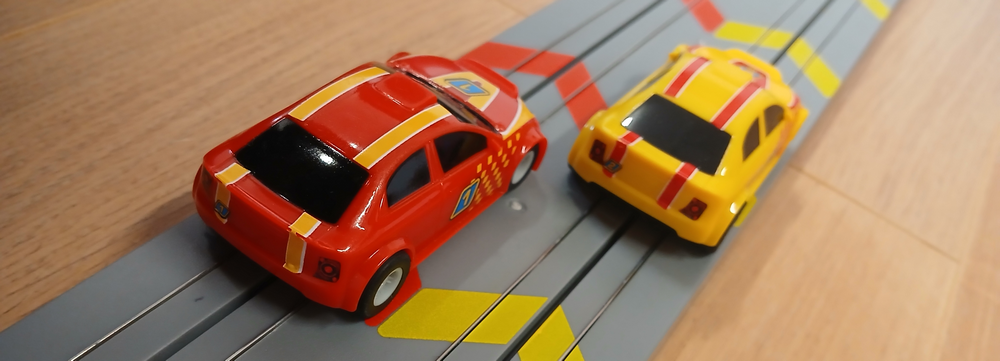
Electrical Transfer Quality and Wear
Carrera (The wide ribbon)
- For braided wires: The braid rubs against a wide, flat surface. As you pointed out, the contact is made on the flat side of the U-shape. This distributes the heat generated by the electric arc (sparks), preventing the braid from burning too quickly in one spot.
- Fouling: The inverted U shape tends to create a slight dome. Dust can slide off the sides, but the total surface area to be cleaned remains significant.
Micro Scalextric (The thin slice)
- For the braids: Contact is made on the edge of the “I” (the metal strip). It’s a “blade-on-blade” contact. The electric arc is highly concentrated on a tiny point.
- Performance: This very fine contact drastically reduces rolling resistance. The car is more “free-moving.”
- Wear: The braids (often rigid strips here) wear down, creating a V-shaped groove from repeated friction against the edge of the rail. Power transfer remains good as long as the car’s spring pressure is sufficient.
Magnetic Behavior (Ground Effect)
C’est là que la différence de géométrie est la plus flagrante :
- Micro Scalextric (vertical I): The magnetic flux must be concentrated on a very thin line (the edge of the I). The attraction is sudden and very strong at the center, but as soon as the car loses traction and the magnet is no longer positioned exactly over the edge of the track, the ground effect disappears instantly. This results in an “on/off” driving experience: it holds very tightly, then suddenly loses traction.
- Carrera (inverted U): The metal mass is spread out. The magnet under the car is attracted uniformly over a wider area. This makes the car more stable when drifting, because the magnet still “sees” a lot of metal even if the rear end slides out.
Synthesis
| Point of view | Carrera (U Profil) | Micro Scalextric (I Profil) |
| Plastic anchor | Double (very robust) | Simple (more fragile) |
| Contact surface | Large and flat | Very thin (slice) |
| Mechanical friction | Higher (brakes the car) | Very low (favors speed) |
| Magnet effect | Progressive and broad | Powerful but narrow |
| Maintenance | Easy (flat surface) | Delicate (risk of catching on the rail) |
It is clear that the Carrera is designed as a “real” reduced-scale racing track, prioritizing the contact area, while the Micro Scalextric is inherited from the HO tradition (a diverted model railway), prioritizing fineness and reduced friction to achieve record-breaking scale speeds.
Compatibility
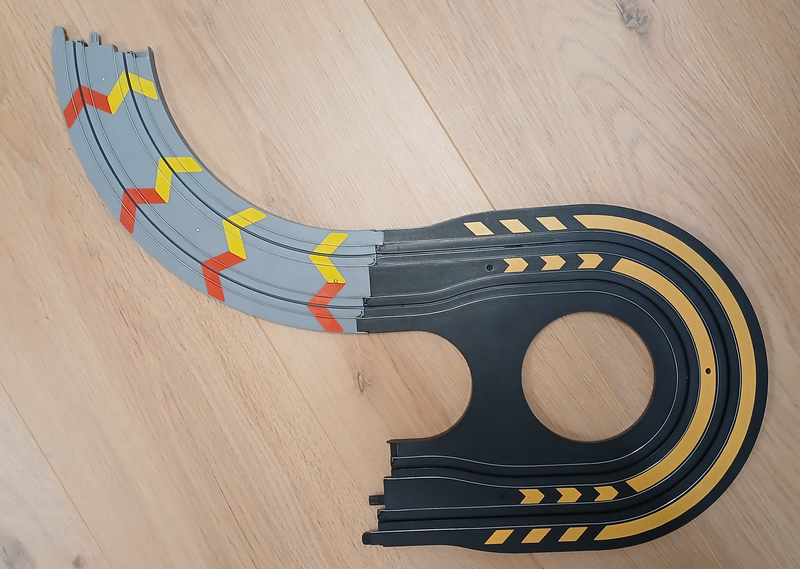
My First Scalextric rails are compatible with Micro Scalextric.
The Carrera First rails are only compatible with themselves but not with the GO Range, due to a difference in scale and therefore track width.
Conduct
As for driving the My First Scalextric vehicles, there’s no problem for younger drivers; the vehicles stay on the track even at full throttle. With Carrera, some vehicles with a high center of gravity may require slowing down a bit.
Availability
Scalextric can be found in France, but only marginally; Scalextric is primarily present in the UK market.
Carrera has a strong presence in France and generally throughout Europe.
Competition between Scalextric and Carrera is very limited in Europe and mainly concerns the UK.
My First Scalextric & Carrera First
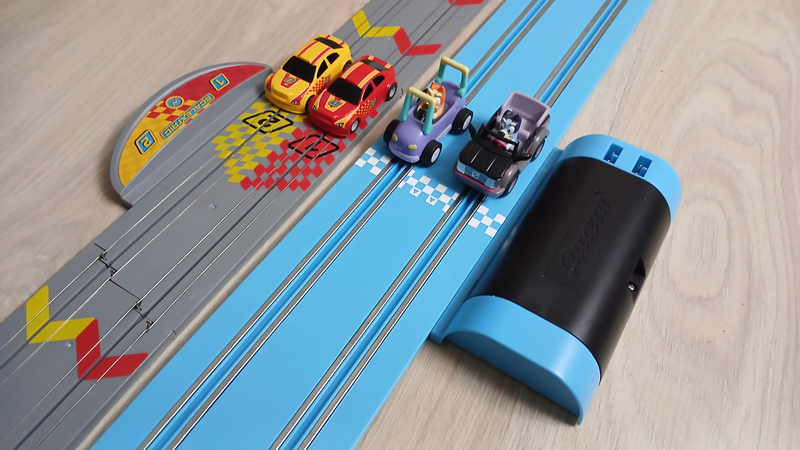
In both cases, a brand name and the word “First” (meaning first) are used for a range aimed at younger players.
The first Scalextric My First sets appeared in 2011, while Carrera released its range in 2016. So there’s a good chance Carrera was inspired!
While Scalextric chose to use the same track as its Micro Scalextric range, Carrera opted to create new track. I can’t fault them for this, as GO track isn’t easy to assemble and disassemble, whereas Carrera First tracks are made of a durable plastic that doesn’t break—a real joy.
Conclusion
Scalextric fans, you can delight your child with a My First Scalextric set, and Carrera fans with a Carrera First set. Both are equally good, each with its own advantages and slight differences. Whichever product you choose, your child will be happy to practice before moving on to the next level.