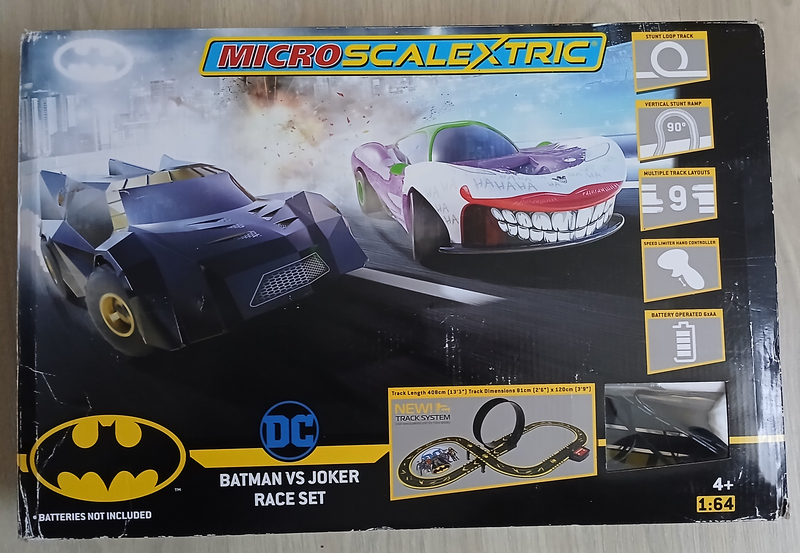
After buying an older generation Scalextric My First track (pre-2019), I also couldn’t resist a newer generation Scalextric Micro track (post-2019). Just to see and compare it with Carrera.
I asked an AI two questions: to compare the Carrera GO and Micro Scalextric ranges, and then to compare Micro Scalextric and My First Scalextric to get an overall view.
Comparison between Carrera GO and Micro Scalextric
1. Scale and Bulk (The Crucible of War)
- Carrera GO!!! (1:43 scale): The cars are approximately 10-11 cm long. This intermediate scale offers superb visual detail and a realistic sliding experience. However, the track requires a lot of space (you’ll often need at least 2m x 1m of floor space for a decent layout).
- Micro Scalextric G1155M (1:64 scale): This moves up to the “HO” miniature format (cars approximately 7 cm long). The Batman set offers a very long track (4.08m) while fitting into a compact rectangle of only 1.91m x 1.32m. Ideal for small bedrooms.
2. Rail Design (Plastic, Grip and Assembly)
- Carrera GO!!!: Black, high-density, rigid plastic track. The fastening system uses optional, very strong mechanical connecting clips (the track doesn’t budge an inch), but these can sometimes be a little difficult for children to handle. The track spacing is wide (60mm), limiting side collisions.
- Micro Scalextric: Uses the Megatrack generation track (black). The plastic is slightly more flexible, and the track is assembled using a direct “click-together” clip system that is much faster and more intuitive to set up and take down on the floor. The track is logically narrower.
3. Electrical components and handles (power management)
- Carrera GO!!! (14.8V): The wired controllers incorporate a mechanical “Turbo” button. It’s a binary system: if the child fully presses the main trigger, the car goes fast, but they must press the Turbo button to navigate the loops without falling. This requires coordination.
- Micro Scalextric Batman (9V): The main strength of this set lies in its controllers equipped with a 4-position electronic power limiter (25%, 50%, 75%, 100%). You can limit the Batmobile to 50% for a young child: they can fully press the trigger without ever going off the track in the turns.
4. Car Mechanics and Maintenance
- Electrical contact: Carrera GO!!! uses classic double copper braids. These tend to fray, get dirty, and require regular adjustment (bending them at the correct angle) to maintain contact. Micro Scalextric uses rigid metal pads guided by springs. These require virtually no maintenance and do not deform.
- Grip: Scalextric’s Magnatraction system literally glues the Batmobile and Joker car to the track thanks to a powerful neodymium magnet under the chassis, making the driving very responsive and fast (a “on-rails” effect), while Carrera GO has a slightly heavier and more realistic feel.
5. System scalability
- Carrera GO!!! wins hands down on this point. The catalog of add-ons (banked corners, bridges, digital lap counters) and cars sold individually (Mario Kart, F1, GT3, etc.) is enormous and readily available in stores.
- Micro Scalextric (at this 1:64 scale) has a more limited catalog of add-ons, especially in continental Europe. This Batman vs. Joker set is designed as a complete and self-contained unit right from the start.
Comparison of MyFirst Scalextric and Micro Scalextric
1. Positioning and Target Age
This is the first major dividing line to explain to your readers.
- My First Scalextric: Designed specifically as the ultimate entry point into the world of slot car racing. It’s aimed at toddlers, generally from age 3. Everything is simplified to the extreme to avoid frustration.
- Micro Scalextric: This is the next step, often recommended from age 4 or 5. It moves beyond the “early childhood toy” category to enter the realm of true miniature slot car racing, with more complex tracks and popular licenses (like the Batman vs. Joker G1155M set).
2. Rail Compatibility and Design
This is the most crucial technical point for parents who want to develop the circuit.
Rail Type
Both ranges now use the 1:64 scale black rail system, but the geometric approach differs:
- My First Scalextric: The sets generally offer an ultra-simple figure-eight layout with a bridge. The goal is to provide perfect equality of length between the two tracks without the need for complex pieces.
- Micro Scalextric: The layouts are much more sophisticated and varied (loops, chicanes, longer extensions).
Backward Compatibility: Beware of the trap!
⚠️ Note: Scalextric changed its 1:64 track system a few years ago, switching to the Megatrack system. Older My First sets (which often had colored, blue or yellow track) are not compatible with current Micro tracks without an adapter. However, modern “My First” sets (with black track) and “Micro Scalextric” sets share the same track connectors and can be used together.
3. Cars: Durability vs. Loyalty
| Characteristic | “My First” range | “Micro” range |
| Design / Look | Cars in “Cartoon” or Fantasy style (usually a red car vs a yellow car), rounded shapes. | Officially licensed replicas (Batmobile, Aston Martin, James Bond, Hypercars). |
| Robustness | One-piece bodies made of ultra-resistant plastic, designed to withstand repeated drops on tiled floors. | More detailed models with spoilers or rearview mirrors that can be more fragile during big crashes. |
| Technique (Scrubbers) | Simplified braided or rigid metal glides, made to last without maintenance. | Rigid pads guided by springs (very efficient system). |
| Magnatraction | Present (powerful magnet to stick to the track), but dosed for moderate speed. | Very powerful, allowing for lightning-fast cornering speeds. |
4. The Power Supply and the Handles (Controllers)
This is where Scalextric technology shines compared to the competition, but with a nuance depending on the range.
- The “My First” Controllers: These are ergonomically designed for the hands of 3-year-olds. Often, the overall power of the track is intentionally limited at the transformer so that the cars stay on the track even if the child holds the trigger down at 100%.
- The “Micro” Controllers (New Generation): These incorporate the renowned 4-position electronic power limiter (25%, 50%, 75%, 100%). This is a huge advantage: the track grows with the child. You start at 25% (My First mode), then increase the power as they get older.
5. Summary for your blog: Which one to recommend?
To conclude :
- Buy “My First Scalextric” if: The child is between 3 and 4 years old, you want a toy that works instantly “out of the box” without any setup, and the design of the cars isn’t important.
- Buy “Micro Scalextric” if: The child is 5 years old or older, is a fan of a particular license (Batman, James Bond, etc.), and you’re looking for a track that you can expand and make more complex later.
Thank you for these comparisons.
Let’s now look at my comments on this Micro Scalextric set.
The rails
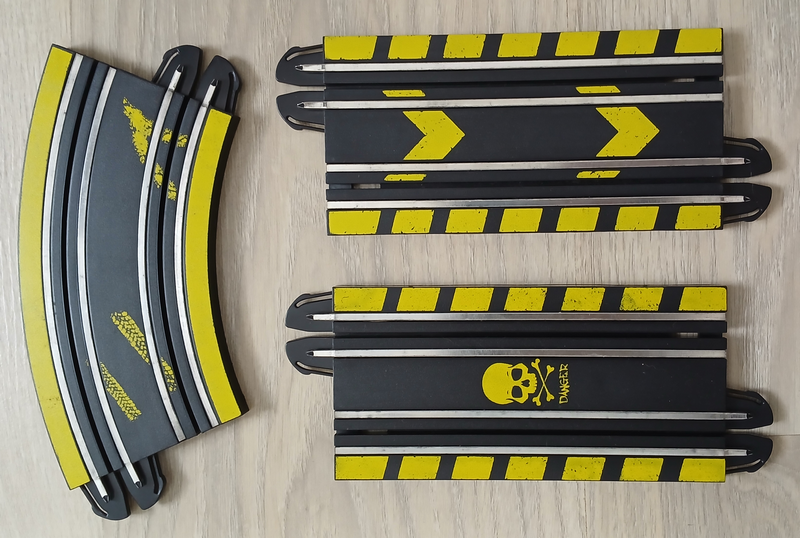
The available track elements are 45° curves and 150mm straight sections.
The track width is 74mm.
Each rail features a decoration. For the straight sections, there are two different versions: a skull and crossbones and arrows indicating the direction of travel (if they are oriented that way!). The curves have tire tracks, identical on all curves. In Carrera GO sets, few straight rails are decorated; we have the starting gate and the curves (most of which are decorated with two colors [White-Red] to represent rumble strips). Only a few straight sections in some sets have decoration, such as in certain “Cars” sets.
One notable feature is the rail connection system, which is practical and much less fragile than Carrera GO’s. The connecting elements are larger and easier to use. There is less risk of breakage during disassembly than with Carrera.
Power supply and departure
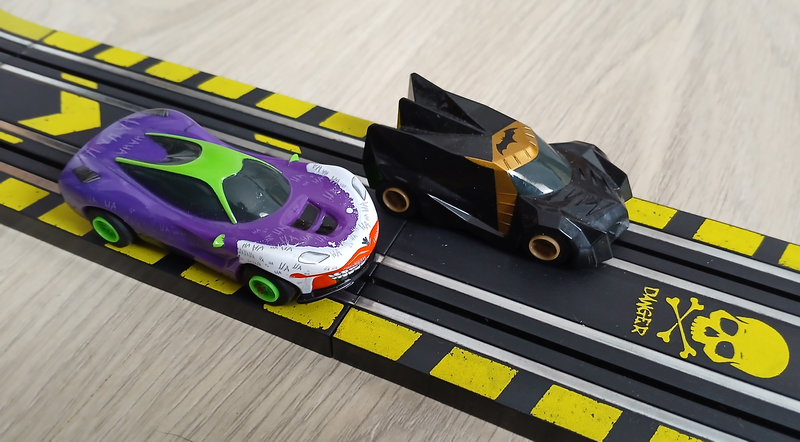
The starting base contains batteries to power the track. Six AA (LR06) batteries are required to provide 9 volts. Note that the instructions specify not to use rechargeable batteries. Rechargeable batteries only provide 1.2V, resulting in a voltage of only 7.2 volts, a deficit of 1.8V, slightly more than a standard battery.
The track is marked with a 1 on one side and a 2 on the other, clearly indicating which controller powers each lane. There is also a number next to each connector where the controllers plug into the control box. This is not the case with Carrera systems, where you have to test the connections beforehand.
Controllers
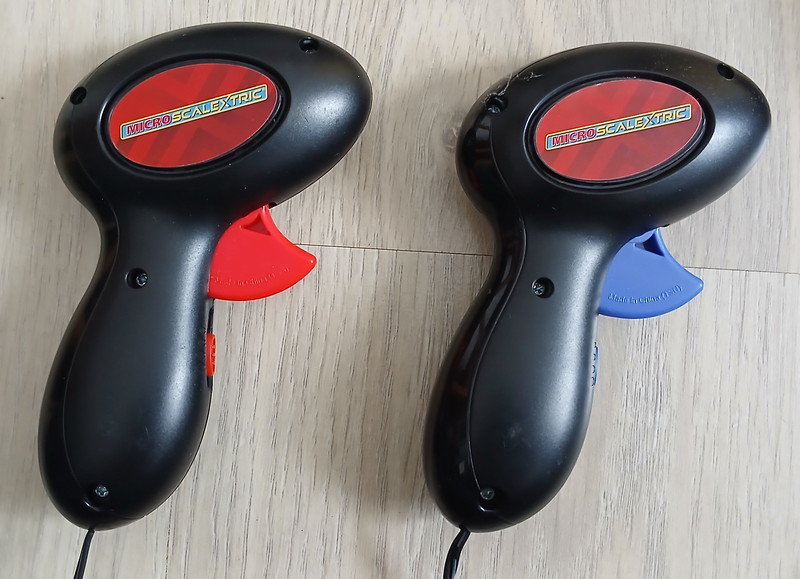
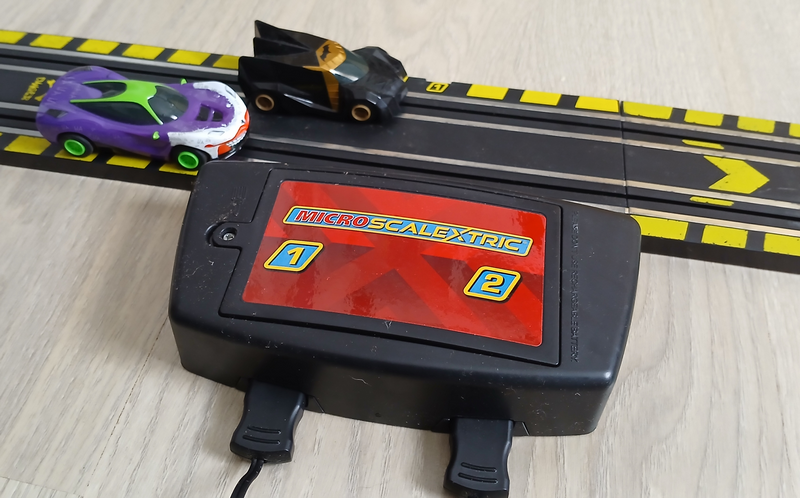
The controllers are the same type as the My First Scalextric pistol-grip controllers, but they’ve been redesigned with a look closer to Carrera controllers in terms of color and rounded edges.
To differentiate the controllers, the triggers are different colors. This is a great idea for differentiation; Carrera controllers in different colors are only found in rare sets or for the 1/332 – 1/24 Digital ranges.
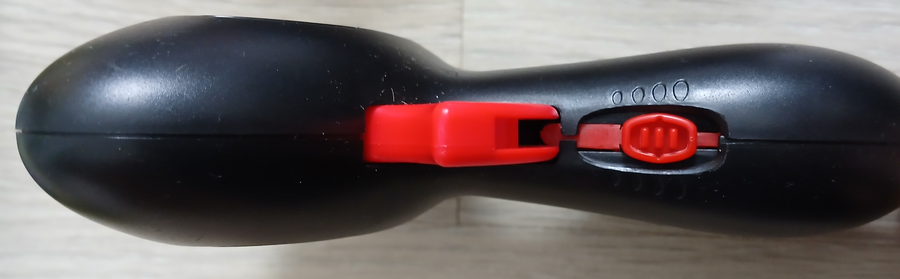
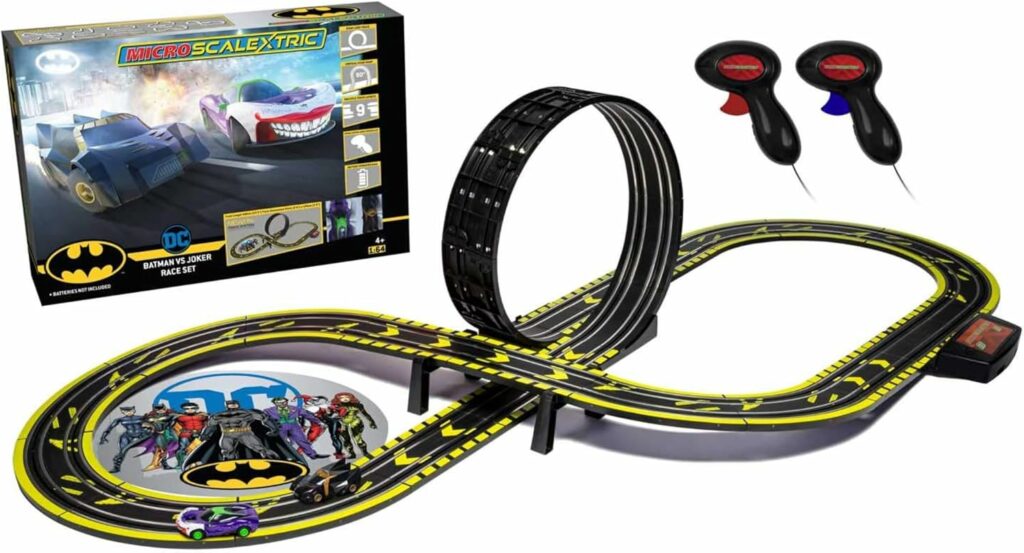
But the feature I love and would love to see from Carrera for the GO range is the small selector on the joystick, which allows you to adjust the maximum power of the controller to 25%, 50%, 75%, or 100% of its maximum power.
So, if the player is having a little trouble driving the car and is going off the track too often, you can lower the maximum power of the car so as not to frustrate the child by going off the track too much. A very good idea. The concept is simple: the selector, which you move, limits the trigger’s travel to varying degrees; it’s a mechanical system. The only device I’ve seen for Carrera GO is a small clip that you put on the pushrod. This was available for the North American sets; I don’t know if it still is. I’ve never been able to find out more.
Looping
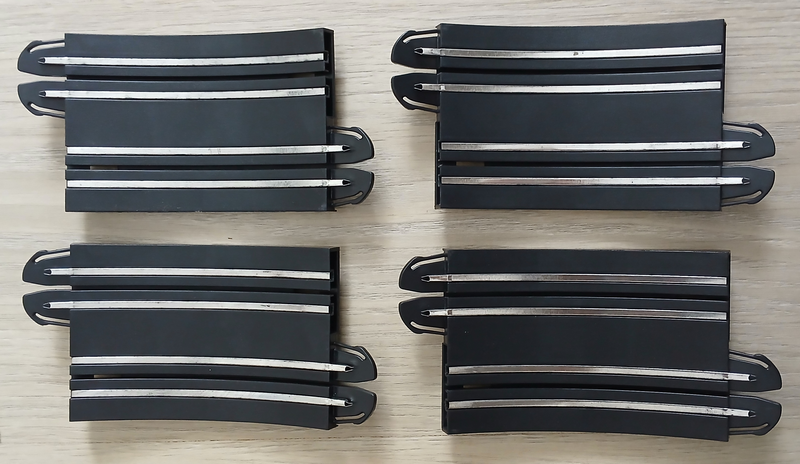
Regarding the loop, there are a few things to discuss; there’s a difference compared to the Carrera GO. For starters, the two tracks are a single piece, whereas the GO tracks are single-track, allowing you to create one loop on one track and another a few dozen centimeters further along, forming several different configurations. Here, we have a double-track loop that always shifts to the right.
There’s less flexibility in its use, but on the other hand, the loop’s support structure makes it very stable, which isn’t always the case with the GO range.
Each loop section forms a 45° arc, so you need 8 elements for a loop.
It’s worth noting that the loop elements are the only track elements without decoration.
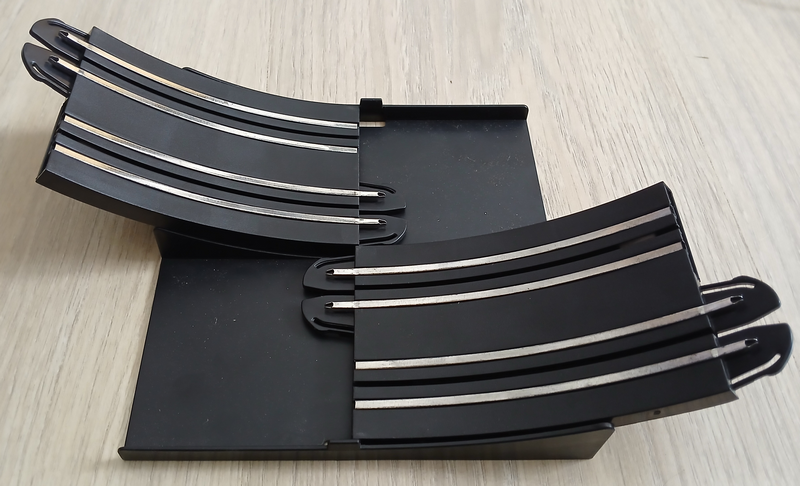
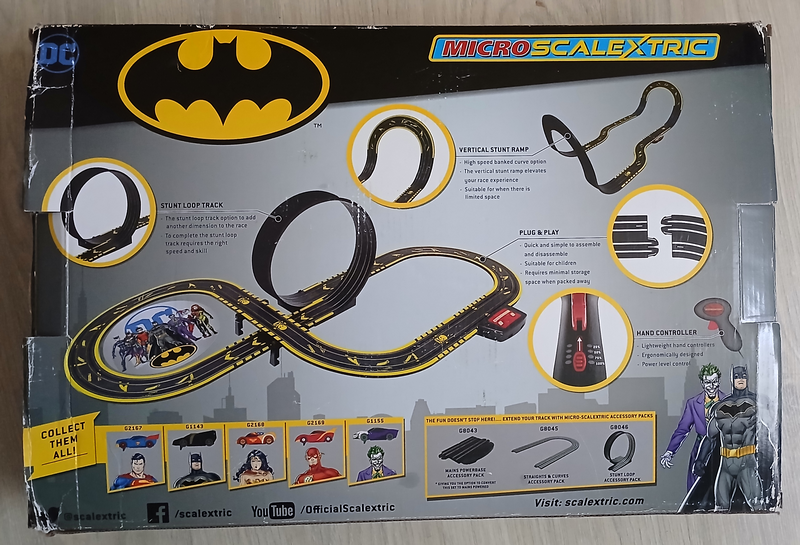
While Carrera uses its loop sections exclusively for loops, Scalextric uses them for flyovers, a particular banked turn. But the Micro range offers something even better with what I call a super flyover perpendicular to the ground (90°, or two 45° sections). It’s very impressive and made possible by a super-powerful magnet that keeps the car glued to the track and prevents it from falling.
Support
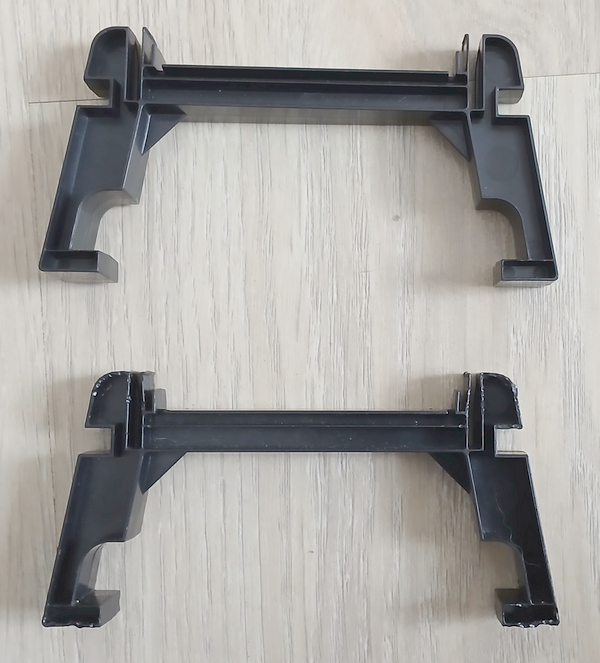
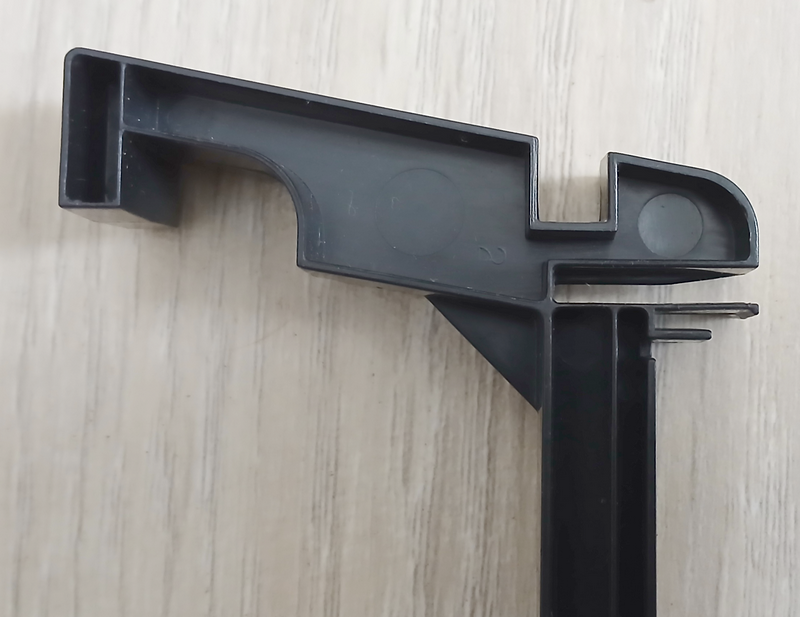
The supports closely resemble those of the Scalextric My First range (pre-2019), with a few minor modifications. The overall design is the same. The part on which the top rail rests has been slightly modified with small tabs that fit into the rail (be careful not to break them).
As with the My First range, the supports are stackable to create multiple heights, which is ingenious and will allow super fans to build tracks in three dimensions (height).
It would be nice to be able to buy these supports separately, but I haven’t found them on the official Scalextric website. Those with a 3D printer and 3D design skills could easily create a similar design for use on their track.
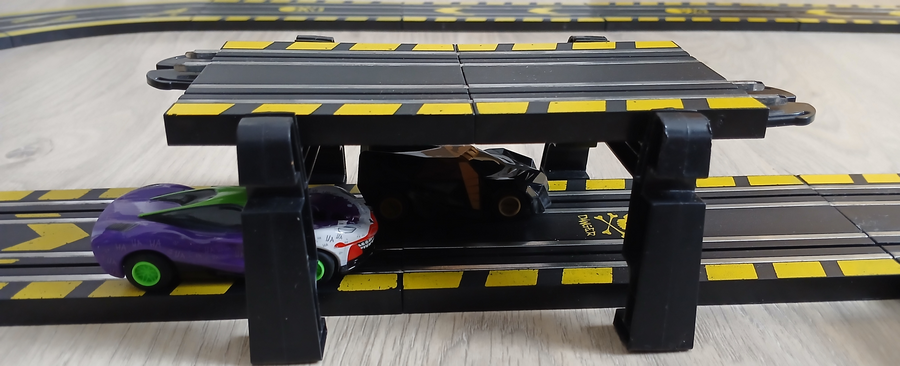
Note that the cars aren’t very tall and it won’t be possible to use taller cars. I’m not familiar with all the types of cars Scalextric offers, but with Carrera, some vehicles like the Mario Kart cars are tall, including the characters’ heads.
Below is an example of a 2-level track
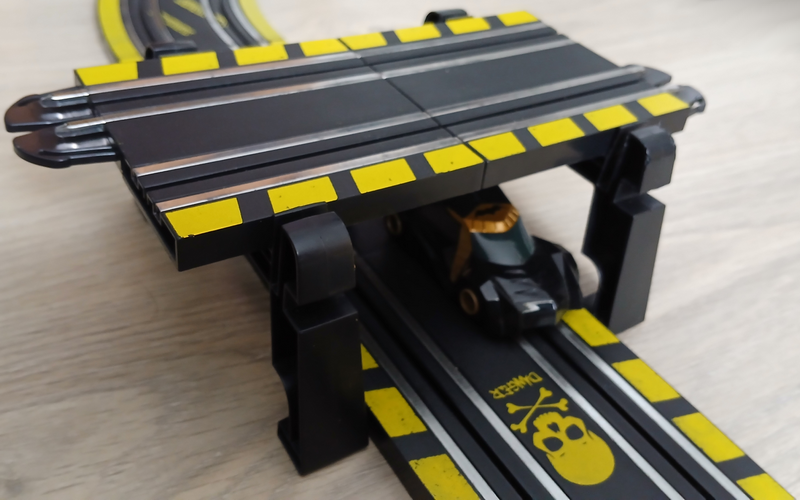
On the left, an example of a track crossing on two levels.
The proposed itineraries
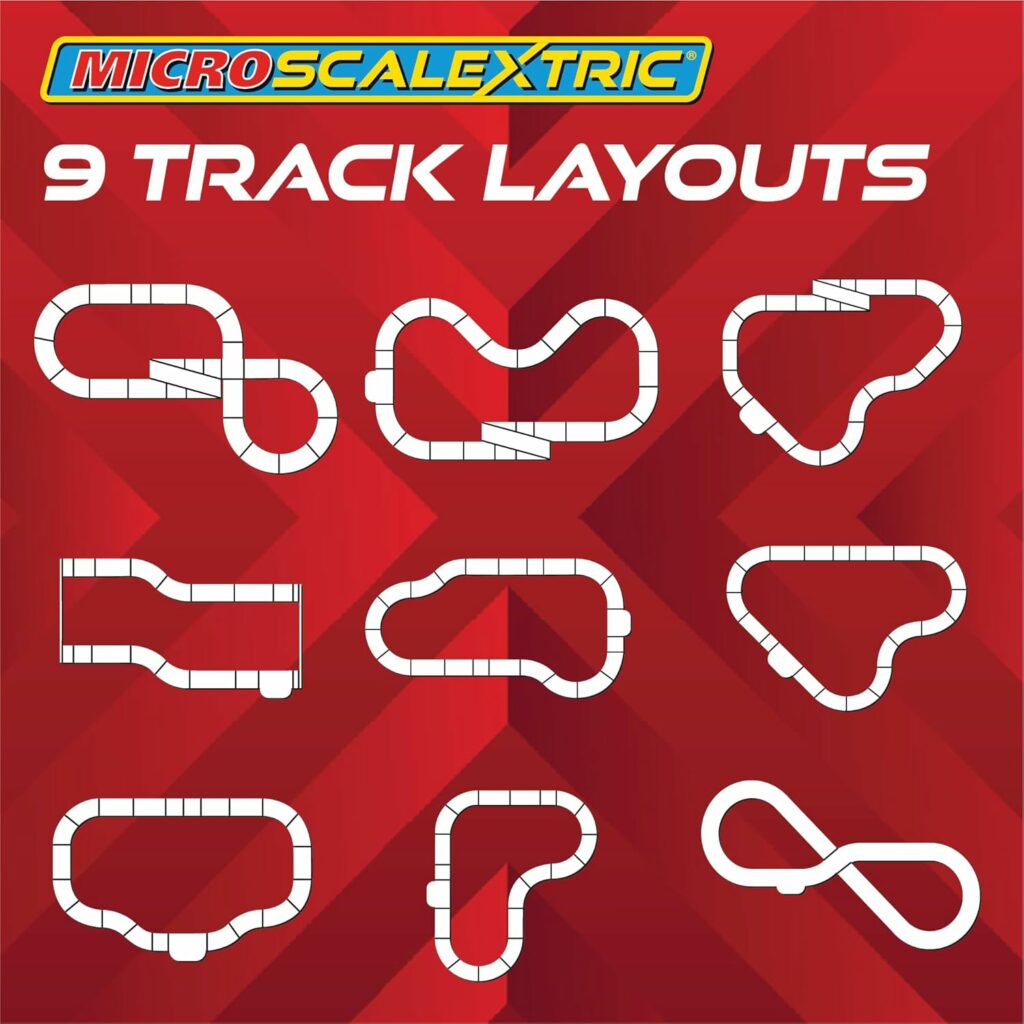
The track layouts offered with the track pieces are quite varied. Having only 45° curves and using loops allows for a nice variety of circuits.
It’s worth noting that the Micro Scalextric range offers few different track pieces. There’s only one radius, and no special features like dirt, ice, lane changes, or narrowing. Carrera GO offers more choices, albeit as optional extras. With Scalextric, it’s the 1/32 scale range that boasts a wide variety of track pieces.
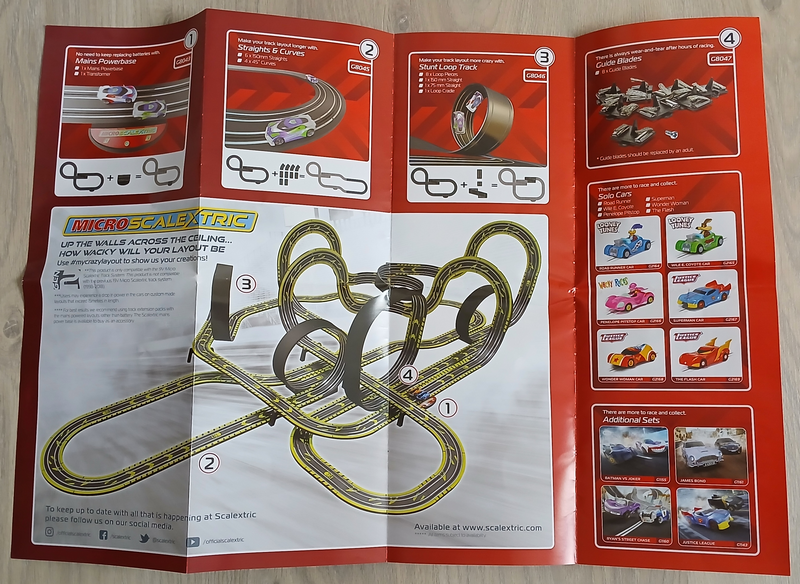
Inside the box, there’s a poster showing what you can create with several sets combined: a totally crazy and fantastic track. I think it’s a shame that Carrera doesn’t include examples of set combinations in its sets or on its website.
Driving
In terms of handling, what struck me most is how strong the magnet is; the car sticks to the track very well. When you slow down, the car stops very quickly, probably due to the strong magnet.
I feel like I can take corners faster than with Carrera GO for the same race on a controller. You can practically go flat out. But not flat out, otherwise you’ll go off the track.
And the power limiter works well, but even at 75% you’re not going off the track much, so you won’t use the remaining 25% very much. But I repeat, it’s great for young children.
Conclusion and comparison with Carrera
Scalextric sets aren’t easy to find in France, while Carrera sets are very common. For children, both sets are great; the differences are minor. However, if you want a large, varied track, Carrera GO offers more different track pieces and is easy to find in stores or secondhand.
I liked the power selector on the controllers of Scalextric tracks.
The track risers are very practical on Scalextric tracks.
The track on Scalextric tracks has a lot of decoration.
There are fewer theme options for the cars on Scalextric.
There are fewer track component options on Scalextric.
Currently, in Europe, there is little competition between Carrera and Scalextric. Carrera’s main competitors are private label tracks, which are very aggressively priced but feature unlicensed cars that are less well-finished and of lower quality. Not to mention that you will find it impossible to find spare parts.
Both Scalextric and Carrera offer braids for sale, which are wear parts that need replacing if you play a lot.
More information can be found on the manufacturers’ respective websites:
Scalextric : https://uk.scalextric.com/
Carrera : https://carrera-toys.com/