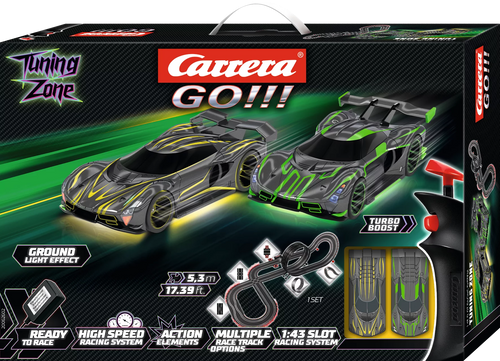
Remember our article on Carrera GO: The cars in the GO Tuning Zone set (https://www.carrera-fun.com/?p=8162) and the articles on Pull and Speed F1 Red Bull Racing Pull N Speed (https://www.carrera-fun.com/?p=8502), Games and Challenges with Pull N Speed (Retro friction) (https://www.carrera-fun.com/?p=8609)
Carrera uses the same bodies for another of its ranges, Pull & Speed.
This range includes Hypercars, and as I mentioned in the first article introducing Pull & Speed, the advantage is that you can use a Pull & Speed body on a GO chassis. This allows you to repair a GO car cheaply. It’s useful for fragile cars like F1 cars.

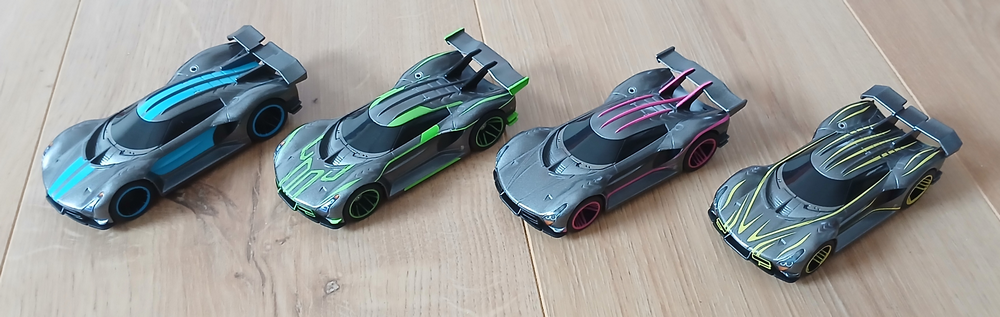
The Pull & Speed Hypercars are interesting because they come in not two, but four colors. In addition to green and yellow, blue and pink are also available.
While the bodywork is identical, there are slight variations on the rear wing, and this is also true for the two new colors.
The Red Bull Racing Formula 1 car tested in January 2026 had the following mechanical characteristic:
A 10cm retraction allows for a 164cm advance.
It will be interesting to test these four cars to compare them with the Formula 1 car, which has a different chassis and bodywork. However, what will be even more interesting is comparing the four Hypercars, which are virtually identical (except for the rear wing).
Green Hypercar: 113-125 cm
Yellow Hypercar: 137-152 cm
Pink Hypercar: 157-175 cm
Blue Hypercar: 163-174 cm
We can see some discrepancies between the models, unrelated to color, but rather to the internal spring mechanism, which likely varies depending on the production batch. The same vehicle produces different results when multiple tests are conducted, probably due to differences in the spring’s release before retraction.
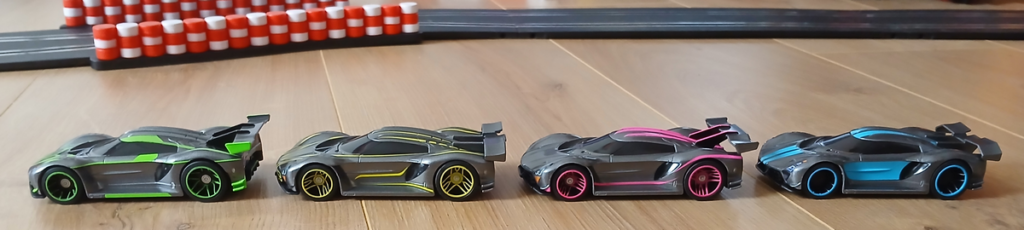
When you have this kind of car, you like it to drive straight. During the test of the 4 cars…
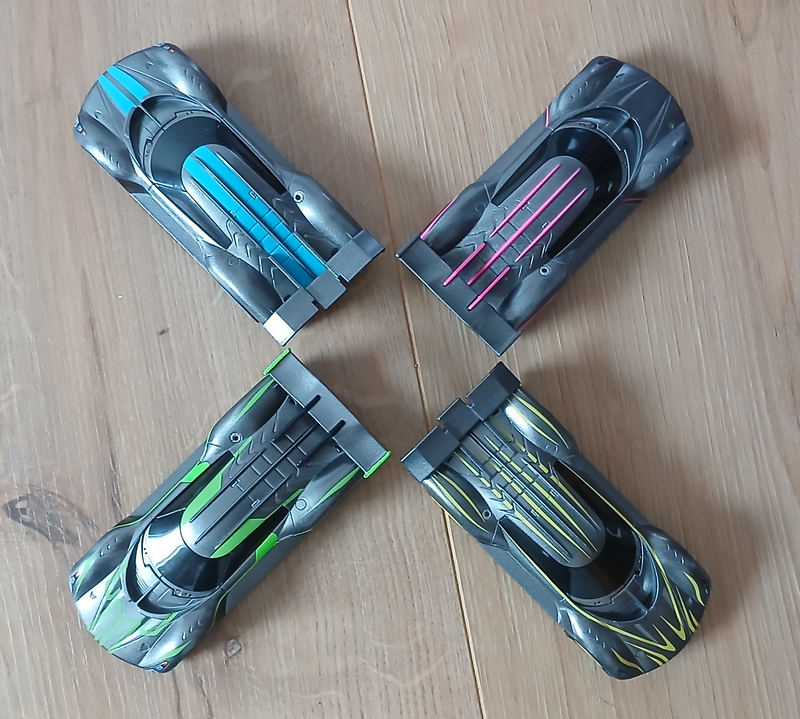
Mechanism
No batteries required, and the car moves relatively fast. I asked the Gemini AI to remind us how this mechanism works.
How does a friction-powered car’s motor work?
Behind this seemingly simple toy lies a purely mechanical mechanism, without batteries: the friction (or pull-back) motor.
The principle is based on kinetic energy stored and then released through three key elements:
- A spiral spring (the “heart” of the system): Inside the car is a thin metal or plastic ribbon wound around itself. When you back the car along the ground, the rear wheels turn gears that compress and tension this spring. The further you back up, the more energy the spring stores in the form of mechanical tension.
- A gear train (the reduction gear): The spring alone would unwind in a fraction of a second. To prevent the car from spinning its wheels, a set of small toothed wheels (the gears) multiplies the movement. It transforms the spring’s force into a smooth and sustained rotational speed for the wheels.
- A clutch or freewheel system: This is the most ingenious component:
- When you back up: a small pinion engages to lock the energy in the spring (you’ll feel a slight resistance and sometimes a click at the end of its travel).
- When you let go of the car: the spring relaxes, releasing its energy to the wheels, and the car moves off. Once the spring is fully relaxed, the mechanism freewheels, allowing the car to continue rolling instead of coming to a sudden stop.
- When you reverse: a small gear engages to lock the energy in the spring (you’ll feel a slight resistance and sometimes a click at the end of its travel).
- When you release the car: the spring extends, releasing its energy to the wheels, and the car moves forward. Once the spring is fully extended, the mechanism freewheels, allowing the car to continue rolling instead of coming to a sudden stop.
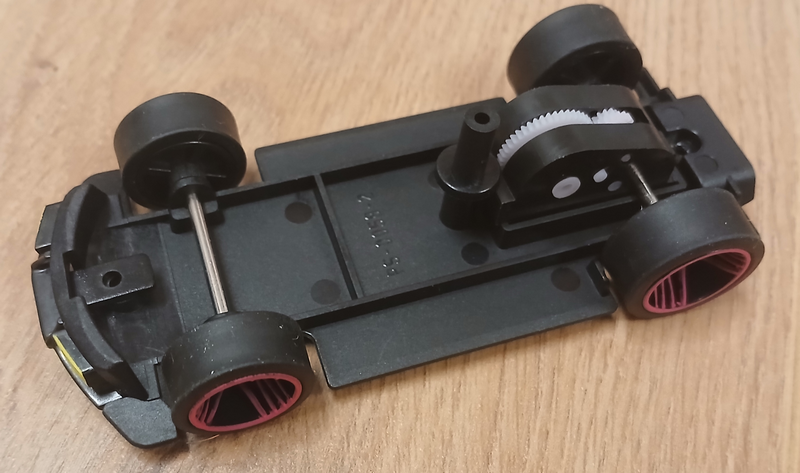
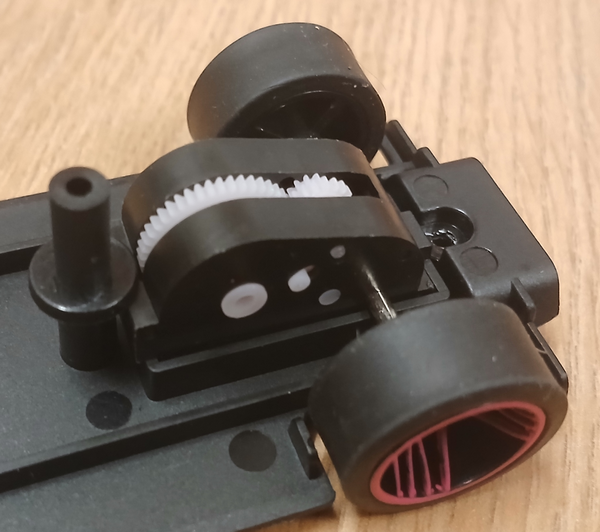
To see what’s inside, I removed the two screws to take off the body. Unsurprisingly, all that’s left is the retro friction unit connected to the rear axle. You can see the module’s gears, which might need monitoring in case dust gets into the mechanism.
I hope you and your children enjoy playing with these Hypercars.
Available in stores or on the Carrera website.